Jul 25, 2026
•Updated on Jul 25, 2026
•8 min read
HVAC Maintenance Checklist: What Goes On It (and What It Won't Tell You)
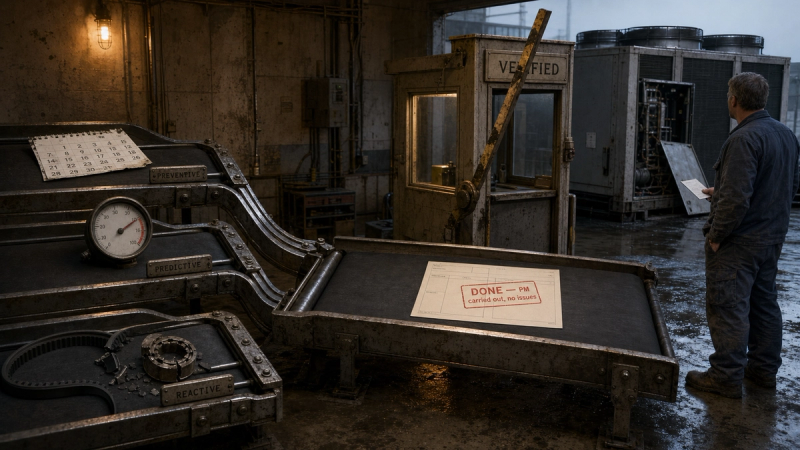
An HVAC maintenance checklist is the list of tasks that keep heating, cooling, and ventilation running: filters, coils, belts, refrigerant, controls, each on a cadence. It tells you what to service and when, not whether the work got done and verified, which is where most HVAC records fail.

Vibha Ramprakash
Co-Founder, CMO/COO
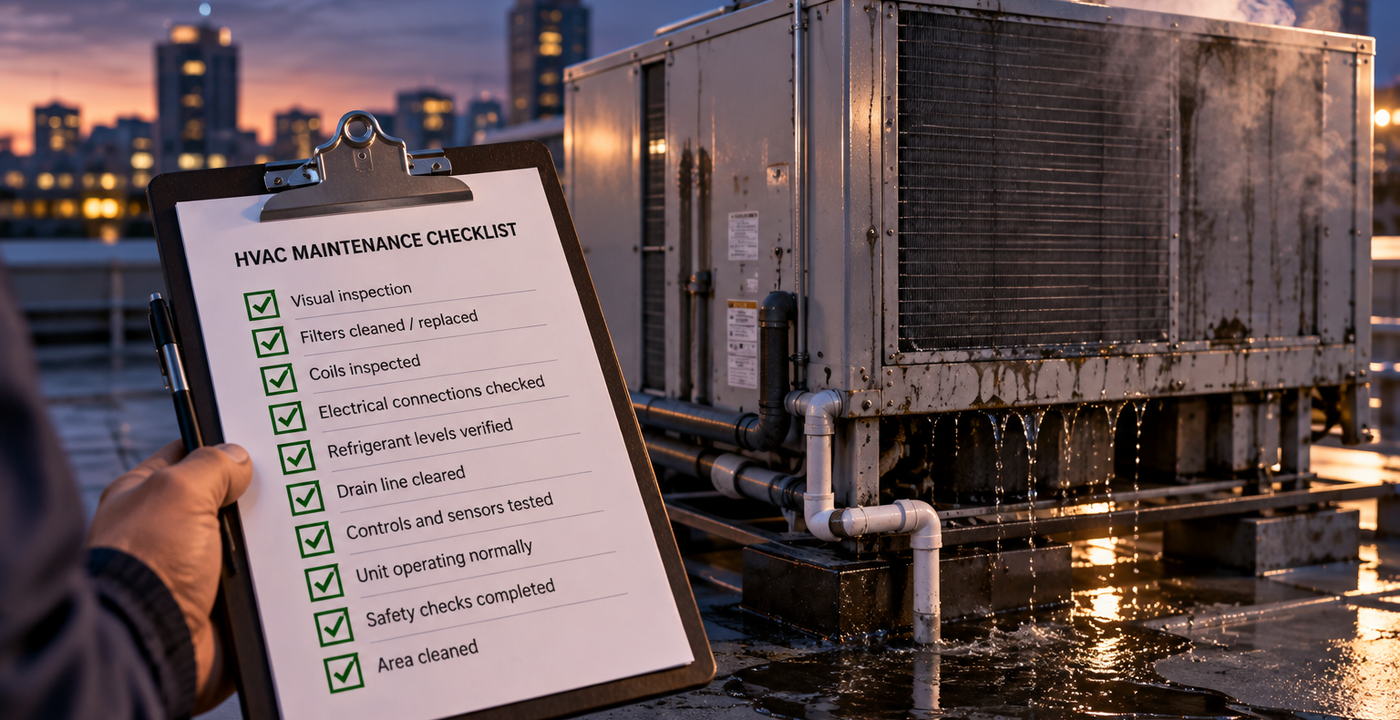
An HVAC maintenance checklist is the standing list of tasks that keep a building's heating, cooling, and ventilation working, each task tied to how often it needs doing: filters monthly, coils and belts each season, a full service once or twice a year. A good one turns a vague promise to service the plant into specific tasks someone can be held to. What it does not do is prove any of those tasks actually happened.
Picture a rooftop unit in August. A technician works down the list, ticks every box, signs it off. Two weeks later the unit trips on a hot afternoon and a tenant is calling about a warm floor. The checklist said the coils were clean and the charge was good. The plant says otherwise. Somewhere between the tick and the truth is the gap this article is about.
What's actually on an HVAC maintenance checklist?
A checklist is organized by how often each task needs doing, because a filter and a compressor do not live on the same clock. Most lists group the HVAC maintenance tasks into a few cadences: things you check monthly, things you do each quarter or season, and things that happen once or twice a year. The equipment decides the exact tasks; the shape stays remarkably consistent across almost every plant.
Monthly, or during heavy use, the airflow items that drift fast:
- Inspect and replace air filters. A clogged filter is the classic hidden energy drain: the U.S. Department of Energy estimates a dirty filter can push a system's energy use up by as much as 15%, which is why ENERGY STAR says check filters monthly and change them at least every three months.
- Check thermostat and control setpoints against the schedule the space is supposed to run.
- Clear condensate drains and look for standing water or overflow.
- Listen and look for the obvious: belt squeal, bearing noise, vibration, anything that changed since last month.
Quarterly or seasonal, before the cooling and heating seasons bite:
- Clean condenser and evaporator coils. Dirty coils make the system work harder and shorten compressor life.
- Inspect, tension, or replace fan belts; lubricate motors and bearings where the manufacturer specifies it.
- Check the refrigerant charge and look for leaks, and test economizer and damper operation.
Annually or semi-annually, the full service and the compliance items:
- A deep inspection of the compressor, heat exchanger, and electrical connections.
- A recorded refrigerant check by a certified technician, which is a legal requirement, not a nicety.
- Calibrate controls, verify safety cutouts, then review the asset's history and adjust the plan.
You will see this same list under a few names. Some teams call it an HVAC PM checklist, others an HVAC preventive maintenance checklist, and a commercial HVAC maintenance program will run several of them at once across dozens of units. The labels vary. The underlying tasks, and the clocks they run on, do not.
How often should each task run?
The cadences are not arbitrary. They come from the manufacturer's intervals, adjusted for how hard the unit works and where it sits. A rooftop unit on a coastal or dusty site runs its filters and coils tighter than the same model in a clean plant room. Start from the recommended interval, then let your own failure history move it: if a unit keeps needing attention between planned visits, the interval is too long, and the checklist should say so.
Once you know what runs monthly, quarterly, and annually, the checklist becomes a calendar. That is why teams map the tasks onto a 52-week PPM planner, so a quarterly coil clean cannot silently slip two quarters without anyone noticing.
Whether a given unit belongs on a preventive schedule at all is a separate call. A cheap exhaust fan might be fine to run to failure; a chiller serving a server room is not. For commercial buildings there is a recognized baseline for all of this: ANSI/ASHRAE/ACCA Standard 180 is the standard practice for HVAC inspection and maintenance, and it puts responsibility for meeting it on the building owner, who can delegate the work but not the accountability (ANSI/ASHRAE/ACCA Standard 180-2018).
The line generic checklists skip: refrigerant is regulated
One innocent line on most templates, "check refrigerant charge," hides a legal requirement. In the United States, anyone who maintains, services, repairs, or disposes of equipment containing regulated refrigerants must hold an EPA Section 608 technician certification under the Clean Air Act. It is not optional and it is not a formality: handling refrigerant without it is illegal, with civil penalties up to $44,539 per violation as of 2026 (U.S. EPA, Clean Air Act Section 608). The UK and EU enforce the same idea through F-Gas rules, which require equivalent certification.
$44,539
maximum EPA penalty per violation for handling refrigerant without Section 608 certification (2026)
So "refrigerant checked" on a signed sheet is really a claim that a specifically certified person did specifically regulated work. A ticked box does not tell you whether the person who ticked it holds the certificate, or whether the reading behind it was ever taken. That is the first crack in trusting a checklist as evidence, and it points straight at the bigger one.
A ticked box is a claim, not a verified fix
A completed HVAC maintenance checklist is a record of what someone said they did. That is not the same as a record of what happened, and on real estates the gap is wide. In our interviews with multi-site FM leaders, 80 to 90% of requesters never go back to confirm a job was actually done, and around 90% of contractor engineers don't follow the full record-keeping process. So the sheet gets marked complete by whoever closed it, not by anyone who checked the work against the outcome.
This bites hardest on the tasks you cannot see from the corridor. A filter change is visible. A refrigerant top-up logged "to spec" on a unit that keeps short-cycling is not. A building management system can tell you a unit is running; it cannot tell you last quarter's service was done to standard. When the only evidence is a tick, a checklist can show a spotless service history on a machine that has been quietly failing for months. The document says maintained. The equipment is the only honest witness, and nobody debriefed it.
A checklist you can trust captures more than a tick. The reading, not just "OK." The measured superheat or the actual filter condition, a photo of the coil before and after, the name of the person who did the work and the certificate they hold, and an honest note on anything left undone or made safe for a return visit. Most templates have no room for any of that, so the richest part of a service, what the engineer actually saw, evaporates the moment they drive away. The tick survives. The knowledge does not. That asymmetry is the whole reason a tidy checklist and a well-maintained asset are not the same thing.
Why your HVAC history can't answer repair-or-replace
The most expensive decision you make on HVAC plant is repair-or-replace, and it is exactly the one a checklist-based history struggles to support. Ask why and the answer is behavior, not software. Engineers write up jobs after the fact, so a two-hour repair lands in the record as a two-minute note. Contractors keep their own paperwork and skip yours. Emergency call-outs handled off-system never reach the asset record at all. What you are left with looks tidy and tells you almost nothing about the true condition or running cost of the unit.
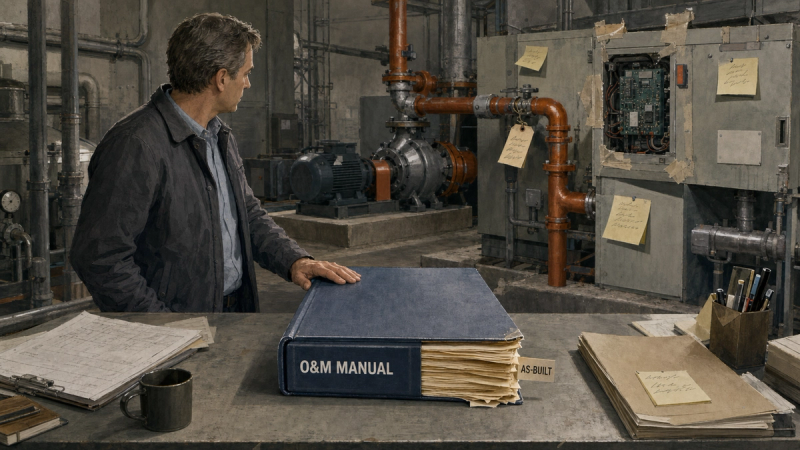
This is why estates running excellent CMMS platforms still can't say with confidence whether a fifteen-year-old chiller is worth another compressor or a capital replacement. The tasks a checklist prescribes usually come straight from the manufacturer's instructions in the operations and maintenance manual. The problem is never the list. It is that what the engineer actually found on the visit rarely makes it back to the record with the same fidelity the list was written with.
What runs the checklist, not just writes it
Everything above is true whether or not you ever change a tool. A checklist tells competent people what to do. Something still has to make sure the right competent person shows up, does it, and leaves an honest record behind. That something is coordination, and it is the first thing to collapse when a maintenance team is stretched, which is why well-run estates still end up with thin, untrustworthy HVAC histories.
At Heyfixit we put AI agents on the work around the checklist, not the wrench work itself. When a planned visit or a breakdown comes up, the agents schedule it, confirm the contractor is certified and insured for the job, chase a real arrival, then verify the work against the job's own evidence instead of a ticked box, writing the confirmed result back to the asset's record as it happens. The checklist still lists the tasks. The agents make sure the tasks turn into a verified, recorded outcome, so the history is one you can actually make a repair-or-replace call from.
4x more productive
helpdesk admin across the work-order lifecycle, in Heyfixit deployments
The honest boundary: Heyfixit is not a CMMS, and it is not an IoT, sensor, or condition-monitoring product. It does not read your equipment or predict failures. It coordinates the human work between statuses on top of the CMMS you already run. Judgment stays human: the agents assemble, chase, verify, and recommend, but a person still makes the calls that carry risk or money. If your HVAC is on a solid checklist and the work still slips after the visit is booked, that gap is the whole point. See how AI agents run the coordination around maintenance.
Frequently asked questions
HVAC maintenance is the routine work that keeps heating, cooling, and ventilation equipment running safely and efficiently. It covers inspecting, cleaning, adjusting, and repairing parts like filters, coils, belts, motors, refrigerant, and controls. Most of it is planned and runs on a schedule tied to each part's needs, so filters get checked monthly while a full service happens once or twice a year. The goal is to catch wear before it becomes a breakdown, hold energy use down, and keep a record of the equipment's condition over time. Done well, it turns surprise failures into predictable, scheduled work.
A typical visit includes replacing or cleaning air filters, cleaning condenser and evaporator coils, checking and tensioning belts, lubricating motors, inspecting electrical connections, testing the refrigerant charge, clearing condensate drains, and calibrating thermostats and safety controls. The exact tasks depend on the equipment and how hard it works. Monthly visits focus on airflow items like filters; quarterly and annual visits go deeper into coils, refrigerant, and the compressor. For commercial buildings, ANSI/ASHRAE/ACCA Standard 180 sets out a recognized baseline for what inspection and maintenance should cover.
It depends on the equipment and its duty, but a common baseline is monthly filter checks, a quarterly or seasonal inspection, and a full service once or twice a year. Filters need the most attention because a clogged one can raise energy use by as much as 15% and strain the whole system. Heavy use, dusty or coastal sites, and critical equipment all push the intervals tighter. Start from the manufacturer's recommended intervals, then adjust based on your own failure history. If a unit keeps needing attention between planned visits, that pattern is telling you the interval is too long.
A checklist is what to do on a single visit. A planned preventive maintenance schedule, or PPM schedule, is when each of those visits happens across the year. The checklist lists the tasks for one service; the PPM schedule spreads every task for every asset across a calendar so nothing is missed. You need both. A checklist with no schedule gets done whenever someone remembers, and a schedule with no checklist tells you a visit is due but not what good looks like when the technician arrives. Together they turn maintenance from reactive scrambling into planned, repeatable work.
For general tasks like changing filters or clearing drains, no. But any work involving refrigerant is regulated. In the United States the technician must hold an EPA Section 608 certification under the Clean Air Act, and doing that work without one is illegal. The UK and EU require equivalent F-Gas certification. So an in-house team can handle routine checks, but the refrigerant and full-service items on your checklist should be signed off by a certified technician. It is worth confirming that whoever ticks those boxes actually holds the certificate, because the checklist itself does not prove it.

Vibha Ramprakash
Co-Founder, CMO/COO
Vibha has spent four years building technology for real estate and asset management operators. Today she works directly with FM leaders across the UK and UAE on the challenges that sit between good technology and the people who have to use it every day.
LinkedIn