Jul 1, 2026
•Updated on Jul 1, 2026
•9 min read
BMS vs CMMS: What's the Difference (and Do You Need Both)?
A building management system controls a building's live systems — HVAC, lighting, access, alarms — while a CMMS is the record of the maintenance work those alarms trigger. They answer different questions, and most teams running real buildings need both. The gap nobody owns sits between them.

Vishak C Prakash
Co-Founder & CEO
A building management system (BMS) and a CMMS solve two different problems. A building management system is the sensor-and-control layer: it runs and monitors HVAC, lighting, access, and fire systems in real time, and raises an alarm when a reading drifts out of range. A CMMS is the record layer — the work orders, the technicians, the history of what actually got fixed. One watches the building breathe; the other remembers what you did about it.
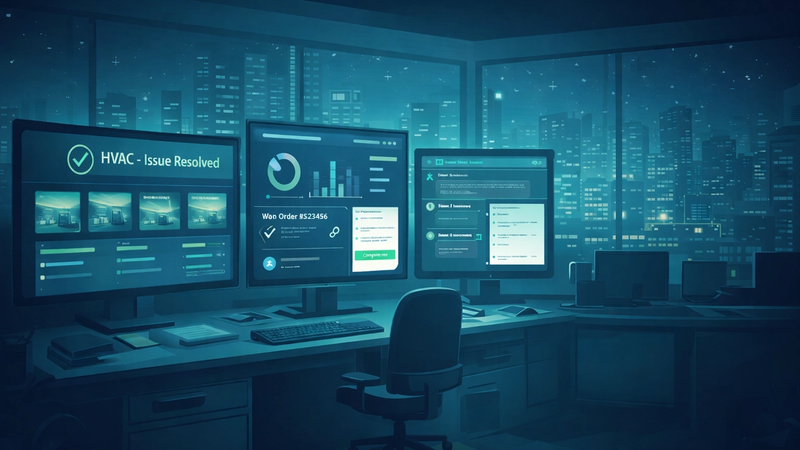
At 2:14 on a Tuesday morning a chiller's supply temperature climbs past setpoint and the BMS fires an alarm. Between that alarm and a technician standing in the plant room, a work order verified and closed behind them, sit a dozen manual steps, and neither system tracks a single one. That gap is what this piece is about.
BMS vs CMMS: what's the difference?
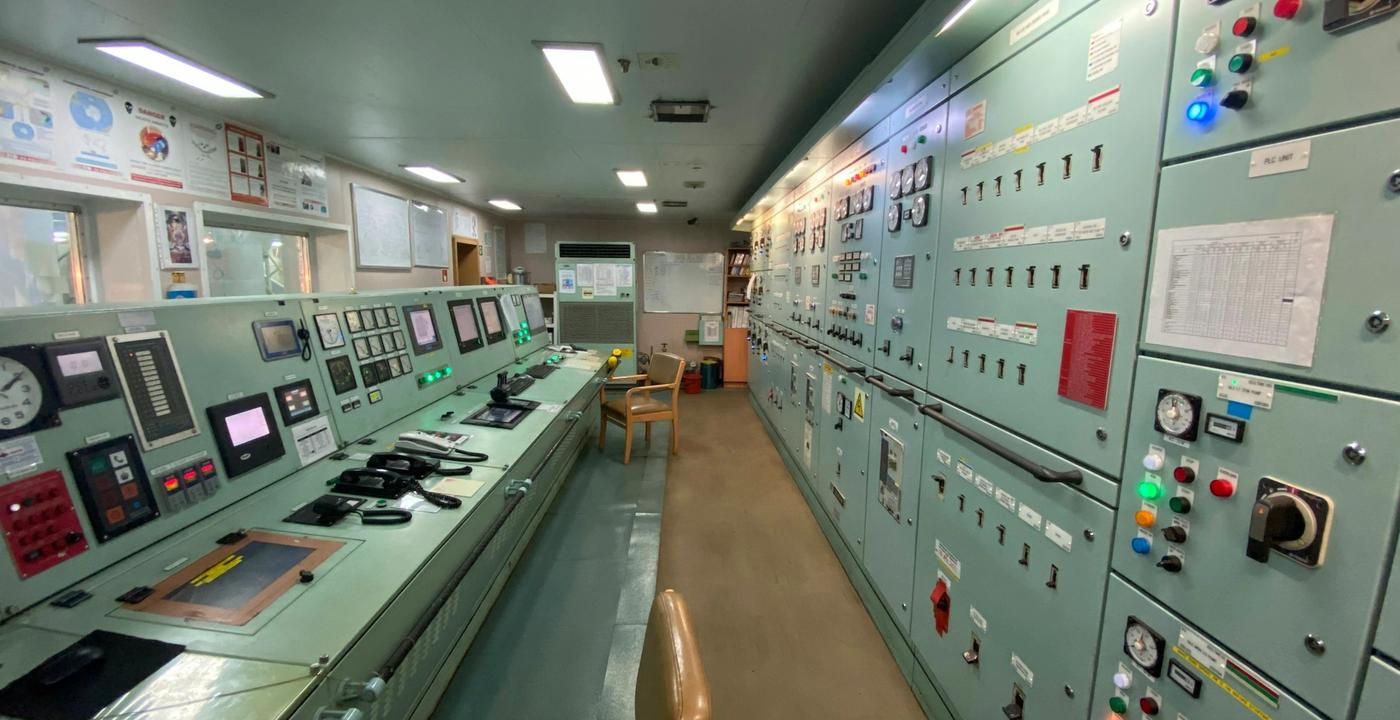
The short version: a building management system watches the building in real time; a CMMS records the work that keeps it running. A BMS lives in the plant room and the risers: controllers, sensors, and actuators wired to equipment, talking over a protocol like BACnet. A CMMS lives on a screen in the FM office, a database of assets, work orders, PPM schedules, and job history. Both touch the same chiller, which is where the confusion starts. But one is asking "is this equipment behaving right now?" and the other is asking "what have we done to this equipment, and what's due next?"
Here's who owns what, and where the two hand off.
| Dimension | Building management system (BMS) | CMMS |
|---|---|---|
| What it tracks | Live equipment readings — temperature, pressure, run status, alarms | Maintenance work — work orders, assets, PPM schedules, job history |
| When it acts | Continuously, in real time, second by second | When a request or a scheduled task is raised |
| Who owns it | Controls / BMS engineers and the energy team | The FM or maintenance team and its technicians |
| At the handoff | Fires an alarm, then goes quiet — it can't dispatch a person | Opens a work order only once someone logs that alarm as a job |
What a BMS actually buys you
A building management system earns its keep on energy and comfort. Buildings account for roughly 30% of global final energy use (IEA, 2024), and heating, ventilation, and air conditioning is the single largest slice of a building's own consumption. A BMS is how you claw that back: it schedules plant to occupancy, trims setpoints, sequences boilers and chillers, and flags a fan drawing more current than it should before it fails outright.
Underneath, it's a network of controllers speaking a common language. Most modern systems talk BACnet, the vendor-independent standard for building automation and control networks (defined as ANSI/ASHRAE Standard 135 and ISO 16484-5), so a Trane chiller and a Honeywell air handler can sit on the same network and be read from one screen. Honeywell, Siemens, Johnson Controls, Trane, and Schneider Electric class vendors define this layer, and they define it well.
What a BMS does not do is manage the fix. When that fan finally trips, the BMS raises an alarm. It cannot open a work order, find an available technician, confirm the visit, or check that the repair actually held. It watches the building; it doesn't coordinate the people who repair it. That job belongs to a different system, and to a lot of manual effort in between.
What a CMMS actually buys you
A CMMS is the mirror image. It knows nothing about live temperature, but it remembers everything about the work. Every asset has a record; every work order carries a status, from created to assigned to in progress to resolved to closed; every PPM task has a due date and a completion stamp. It's the system your auditor asks for, the one your CapEx case is built on, the one that answers "when did we last service this, and what did it cost?"
Notice what a CMMS is built around: states. A work order sits in one status until something moves it to the next. That model is universal, and it's also the CMMS's blind spot. The record shows you that a job went from assigned to resolved. It shows you nothing about the hours of acknowledgment-chasing, access-wrangling, and report-hunting that actually moved it there. The states are visible. The work between them is not, and that work is where most of the effort and most of the truth about the job live.
The line between a CMMS and the CAFM software many estates run alongside it is worth understanding, and we draw it in CAFM vs CMMS: what's the difference. For this comparison the point is narrower: a CMMS records work that someone else has to set in motion. It's a ledger, not a dispatcher. It waits for a human to translate an event in the building into a job in the database — and that translation is exactly where things break.
The handoff between a BMS alarm and a closed work order
Here's the position this whole comparison has been circling toward: the interesting problem is neither the BMS nor the CMMS. Each is genuinely good in its lane, and the SERP is full of vendors who'll tell you so. The problem is the space between them — the handoff nobody sells and nobody owns.
Walk the 2:14am chiller alarm through it. The BMS fires. A duty manager or an out-of-hours line has to notice, decide it's real and not a flaky sensor, judge whether this is a wait-till-morning or a get-someone-out-now, and open a work order in the CMMS. Then someone finds a contractor who covers refrigeration on that contract, confirms they've acknowledged, chases a named engineer, sorts access, and, after the visit, chases the service report, checks the fix actually holds, and moves the work order from resolved to closed.
Not one of those steps lives in the BMS. Not one of them lives in the CMMS. As Heyfixit frames its own model of this: the customer's CMMS/CAFM stays the record, but the work between those statuses (the acknowledging, dispatching, chasing, verifying) lives in inboxes, phones, spreadsheets. The two systems you paid for track the states. A human tracks everything between the states, by hand, usually at 2am.
80–90%
of requesters never go back to confirm a job was actually done — completion gets claimed, not verified
Heyfixit interviews with multi-site FM leaders, 2026
So the work order closes as "done" whether or not the chiller is holding temperature, because no step in either system checks. Someone, or something, has to own that middle. It's the whole premise of an AI helpdesk for facilities management: the coordination between an alarm firing and a job actually closed is a job in itself, and right now it's the most expensive unstaffed role in the building.
Do you need a BMS, a CMMS, or both?
It depends on what you actually operate. Here's how the choice breaks down honestly.
You need a building management system when:
- You run plant that has to be controlled and monitored live — chillers, boilers, air handlers, a serious HVAC estate.
- Energy cost or carbon reporting is a live pressure and you need to schedule, sequence, and trim consumption.
- You have life-safety, access, or lighting systems that need central monitoring and alarms.
You need a CMMS when:
- You have assets to maintain and a maintenance team, in-house or contracted, doing the work.
- You need an audit trail of compliance certificates, PPM completion, and job and cost history.
- Anyone above you asks "what have we spent on this asset, and should we repair or replace it?"
You need both when:
- You run a building complex enough to justify a BMS and a maintenance operation big enough to justify a CMMS, which describes most mid-to-large commercial estate.
- A single small site with a handful of assets might run a CMMS alone; a new smart building might have a sophisticated BMS and still log its maintenance in spreadsheets.
The moment both exist, the handoff between them becomes yours to solve, because no vendor sells the bridge. Which raises the more uncomfortable question: even with both systems running perfectly, can you trust the record they leave behind?
Why the record between them can't be trusted
Even with both systems in place, the data that comes out the other end is thinner than it looks — and it's a human-behavior problem, not a software one.
Here's the mechanism. The BMS produces clean, dense data because machines write it. The CMMS produces patchy data because people write it, after the fact, under time pressure. Engineers log a two-hour job as two minutes on site. Problem and resolution codes get skipped. Contractors keep their own records and treat the client's CMMS as admin they'd rather not do — as one FM leader put it, only after the SLA is breached is there an action. The alarm was precise to the second. The record of what actually fixed it is a guess.
That's why so many estates run a world-class CMMS and still can't answer the questions that matter — total cost of ownership, repair versus replace, what to put in next year's CapEx. The states are all there. The work between them, the part that would explain them, was never captured. The shift from CMMS to AI agents is really a shift in who captures that middle.
Put a number on it. A mid-size site closing two hundred reactive work orders a month, at thirty to forty minutes of coordination per job (noticing, translating, dispatching, chasing, writing up), is burning close to three full working weeks on coordination alone. Almost none of that effort lands in either system as data you can later trust. It evaporates into inboxes and phone calls, and takes the asset history with it.
That's the quiet cost of treating the handoff as somebody's side task. Not just the lost hours, but a maintenance history with holes in exactly the places a repair-versus-replace decision needs to read clearly. A precise alarm at 2am deserves a precise record by morning. Right now it rarely gets one.
Where the alarm-to-closure handoff gets solved
So you have a BMS watching the building and a CMMS recording the work. What you don't have, and what nobody sold you, is anything that runs the middle, the manual relay between an alarm firing and a work order verified closed. That's the layer Heyfixit builds.
We're not a BMS, and we don't want to be. We don't read your sensors, control your plant, or do predictive maintenance or IoT condition monitoring. That's the sensor-and-control category, and vendors like Honeywell and Siemens own it. We're not a CMMS replacement either; your CMMS or CAFM stays the system of record, with named integrations into it. Heyfixit is the coordination layer on top. When an alarm becomes a job, AI agents take it from there: they open and route the work order, dispatch and chase the right technician, verify the fix against the actual service report, and write the finished record back — while a human keeps every judgment call. The point isn't a smarter alarm. It's that the work behind the alarm actually gets done, checked, and captured, so the record finally matches reality.
For one multi-site FM provider, moving that coordination off human desks freed up 60 staff-hours per week at 98% SLA compliance. The chasing stopped being someone's entire day, and the SLAs stopped being a monthly surprise.
If your BMS and your CMMS both do their jobs and the week still disappears into the gap between them, that gap is what we coordinate.
Cover image by Dmitrijs Safrans on Unsplash.
Frequently asked questions
A building management system includes the controllers, sensors, and software that monitor and run a building's core systems. Typically that means HVAC (heating, ventilation, and air conditioning), lighting, and often access control, fire detection, and energy metering. Field devices measure conditions like temperature and pressure, controllers act on that data to hold equipment at setpoint, and a central interface lets an operator see the whole building, set schedules, and respond to alarms. Most systems connect over a shared protocol such as BACnet so equipment from different manufacturers can work together. What a BMS does not include is the maintenance record. That lives in a separate CMMS.
It varies widely, so treat any single figure with caution. Cost depends on building size, how many systems you connect, whether you are retrofitting an existing building or specifying a new one, and how much control you want. A small commercial building might see a modest fit-out, while a large or complex estate can run into six figures once controllers, sensors, wiring, software, and commissioning are counted. Ongoing costs matter too, including licensing, support contracts, and periodic recommissioning. The usual justification is energy. Because HVAC is the largest slice of most buildings' energy use, a well-tuned BMS is normally sold on the energy it saves over its life.
AI shows up in building management in two different places. Inside the BMS, machine learning can tune HVAC schedules to real occupancy, spot equipment drifting toward failure, and optimize energy use beyond fixed rules. That is the sensor and control layer getting smarter. Separately, AI can run the coordination that neither the BMS nor the CMMS covers: taking an alarm or a request, opening the right work order, dispatching the right person, chasing the update, and confirming the job was actually done. The first kind makes the building run more efficiently. The second kind makes sure the work behind an alarm actually gets finished and recorded.
In an HVAC context, BMS stands for building management system. It is sometimes called a building automation system (BAS) or building energy management system (BEMS), and the terms overlap heavily. In all cases it refers to the centralized controls that run and monitor a building's heating, ventilation, and air conditioning, along with related systems like lighting and access. HVAC is usually the largest thing a BMS controls, which is why the two are talked about together. The BMS decides when plant runs, holds it at setpoint, and raises an alarm when something reads out of range. It does not manage the repair once that alarm fires.
Often, yes, because they do different jobs. A BMS controls and monitors your building's live systems; a CMMS records the maintenance work that keeps those systems running. If you operate significant plant, you likely need a BMS. If you have assets to maintain and any compliance or audit obligation, you need a CMMS. Most mid-to-large buildings end up with both. The catch is that neither system manages the handoff between them, when a BMS alarm has to become a verified, closed work order. That coordination is still manual in most operations, and it is the real gap to plan for once you have both.

Vishak C Prakash
Co-Founder & CEO
Vishak spent six years as a digital transformation consultant to facilities management and real estate operators across the UK, Middle East, Canada, and Australia — working with teams at CBRE, Siemens UK, British Land, and Brookfield. He now runs Heyfixit, building AI agents for facilities management.
LinkedIn