Jul 7, 2026
•Updated on Jul 7, 2026
•8 min read
Preventive vs Predictive vs Reactive Maintenance: How to Choose
Preventive vs predictive vs reactive maintenance isn’t a pick-one decision — one site runs all three at once, matched asset by asset to what failure costs. The trigger you pick sets the schedule; whether anyone verifies the work is what sets the outcome.

Vishak C Prakash
Co-Founder & CEO
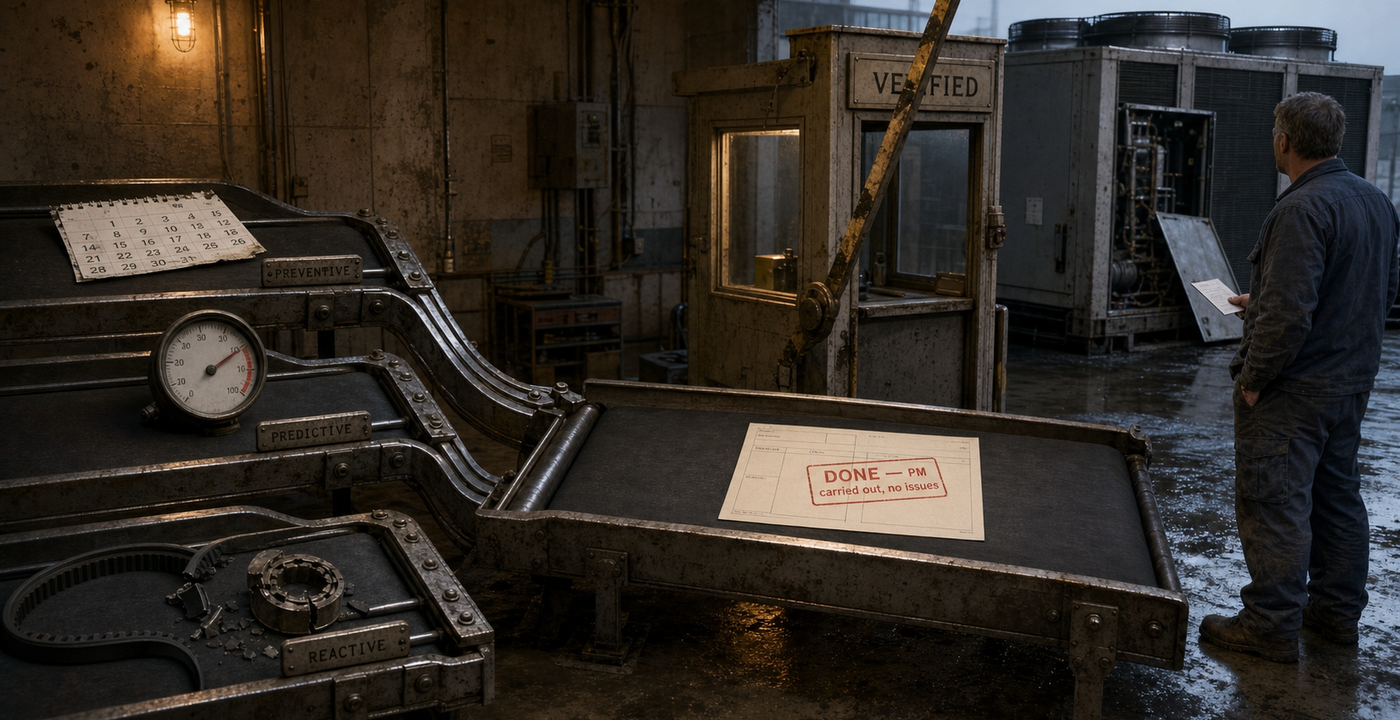
Preventive vs predictive vs reactive maintenance: which one should you actually run? Almost always all three, on different assets. Preventive means you service equipment on a schedule, needed or not. Predictive means sensors watch the equipment and flag wear before it becomes a failure. Reactive means you fix things after they break. Every guide covers that much. The question they skip is the one that decides the outcome: once the job goes out, who checks the work was actually done?
Here's why that question matters. Last August a chiller died three weeks after its preventive visit was signed off. The service report was one line: "PM carried out, no issues." No readings, no photos, no parts list. The schedule got followed; nobody knows if the work did. Picking a maintenance strategy takes a spreadsheet and an afternoon. Running one is where portfolios bleed.
Preventive vs Predictive vs Reactive Maintenance at a Glance
| Factor | Reactive | Preventive | Predictive |
|---|---|---|---|
| Trigger | Asset fails. | Fixed schedule (time or usage). | Condition data crosses a threshold. |
| Best for | Low-cost, low-criticality assets. | Assets with a known wear pattern. | High-value assets with volatile failure patterns. |
| Upfront cost | Lowest. | Low-to-moderate (labor, parts). | Highest (sensors, integration, data pipeline). |
| Unplanned downtime risk | Highest. | Moderate (parts replaced too early or too late). | Lowest. |
| Data required | None. | Manufacturer intervals / usage counters. | Continuous sensor or BMS data. |
| What decides if it worked | Someone confirms the fix held. | Someone confirms the visit happened. | Someone confirms the alert got actioned. |
What Is Preventive Maintenance?
Preventive maintenance is scheduled work performed at fixed intervals (a set number of days, or a set number of run-hours) to keep an asset from failing, regardless of whether it’s showing signs of wear yet. A rooftop unit gets filter changes every 90 days. An elevator gets its certified inspection every 12 months. The interval comes from the manufacturer’s spec or the asset’s own failure history, not from what the equipment is doing right now.
The trade-off everyone names is that preventive replaces parts on a calendar, not on need: some get swapped with life left in them, others fail between visits anyway.
The trade-off nobody names is quieter. A preventive program is only as real as its completed visits, and completion is exactly what goes unwatched. In our interviews with multi-site FM leaders, about 90% of contractor engineers don’t follow the CMMS process to the letter, so a visit marked “done” routinely carries no readings, no photos, no confirmation the right work happened, which is how you get a chiller that was serviced on paper and dead in August. A missed visit is worse, because nothing raises its hand: a schedule doesn’t chase itself, and the escalation only starts once something breaks. As one FM leader put it, “It’s not if they accept. It’s if they acknowledge in time.”
What Is Predictive Maintenance?
Predictive maintenance uses condition data (vibration, temperature, oil analysis, BMS trend data) to schedule work only when an asset is actually showing signs of failure, not on a fixed calendar. A vibration sensor on a chiller compressor flags a bearing wearing out weeks before it fails; the work order gets raised against the sensor reading, not the calendar.
Worth being direct: predictive maintenance is condition-monitoring and IoT-sensor technology — a different product category, and the space where vendors like Oxmaint and Tractian build. That technology generates the alert. What it doesn’t touch is everything that has to happen after the alert fires, and that gap is the same one preventive and reactive leave open too.
That distinction matters more than it sounds, because the sensor is the cheap half of predictive maintenance. The expensive half is everything after the alert: the work order raised, the right technician dispatched, the fix verified. A bearing alert that sits unactioned for a week is worth about as much as no sensor at all. “Nobody is proactively tracking,” one FM leader told us, “only after the SLA is breached is there an action.” Predictive maintenance moves the warning earlier. On its own, it does nothing about who acts on it.
What Is Reactive Maintenance?
Reactive maintenance (also called run-to-failure or corrective maintenance) means fixing an asset after it breaks, with no scheduled inspection beforehand. For a $40 space heater, that’s the right call: monitoring or scheduling upkeep on it would cost more than replacing it when it dies. For a rooftop chiller serving a data hall, it’s a bad call: the failure cost (downtime, emergency service, tenant impact) dwarfs anything saved by not maintaining it.
Reactive is also where the verification gap is widest, because reactive work moves fast and closes faster. In our interviews with multi-site FM leaders, 80–90% of requesters never verify that reactive work was actually completed to spec. The tenant who reported the fault is never asked to confirm the fix; the job gets marked closed and everyone moves on. “Otherwise they will never be the one who verifies,” one leader said of the person who raised the ticket.
And when the fault comes back, the clock matters. In our interviews with multi-site FM leaders, the recall window in which a repeat failure is the contractor’s cost to put right, not yours, typically runs 10 to 14 days (field-service data). If nobody is tracking completion, that window quietly expires, the job gets logged as a fresh call, and the recharge is rarely recovered. The strategy was reactive. The outcome is you paid for the same fault twice.
How to Decide: A Criteria Block
No portfolio picks one strategy. A single site runs all three at once, asset by asset, so the real question isn’t which strategy is best, it’s which strategy each asset earns. Run each one through four questions in order:
- What does failure cost? If failure is cheap (a burnt-out bulb) and safe, reactive is defensible. If failure means downtime, safety exposure, or a breached SLA, it isn’t.
- Does the asset fail on a predictable schedule, or unpredictably? Predictable wear (filters, belts, fluids) fits preventive. Unpredictable, condition-driven failure (bearings, motors, compressors) is what predictive maintenance was built for.
- Can you afford the sensor and data investment predictive maintenance requires? Predictive only pays off on assets valuable enough to justify the upfront sensor and integration cost. It doesn’t scale down to every asset in a portfolio.
- Who verifies the work got done, and how? This is the question the first three set up, and the one that decides whether any of them are real. Preventive, predictive, and reactive all end the same way: a technician who was supposed to do something, and a record that says they did. If nobody confirms completion against the actual scope, you aren’t running a maintenance strategy. You’re running “asset fails eventually, sometimes with a warning,” and paying for the paperwork that says otherwise.
The U.S. Department of Energy’s Operations & Maintenance Best Practices Guide puts numbers on the trade-off: predictive maintenance runs 8–12% cheaper than preventive maintenance, and up to 40% cheaper than reactive maintenance, once sensor and program costs are accounted for (U.S. Department of Energy, Operations & Maintenance Best Practices Guide, 2010). That gap is why high-value, high-consequence assets migrate toward predictive over time, and why it still doesn’t make sense for the low-value ones.
Choosing Is the Spreadsheet. Running It Is the Work.
Picking a strategy is a spreadsheet exercise: failure cost in one column, sensor cost in another, an afternoon to sort your asset register into buckets. Running the strategy is the part that eats the year. Every trigger type drops the same coordination work on someone’s desk: a contractor to chase for acknowledgment, a visit window to confirm, a service report to read, a completion to verify before the job is closed. That work lives between “work order created” and “work order closed,” and most CMMS platforms record the two endpoints while tracking nothing in the middle.
That middle is what Heyfixit does, and it does it the same way no matter what pulled the trigger. When a preventive visit comes due, it dispatches the vendor and chases the technician for acknowledgment; if the acknowledgment doesn’t land in time, it withdraws the job and reassigns to the next resource, so a silent no-show becomes a re-dispatch instead of a missed month. When a predictive alert or a reactive call comes in, over WhatsApp, phone, or email, 24/7, it identifies the caller and asset, raises the work order, and matches a certified vendor. On site, checkout is 60 seconds of the technician texting at the door while the agent structures the readings, photos, and parts into a service report, so completion carries evidence instead of “PM carried out, no issues.” If the fix was only temporary, the requester is told honestly that it was made safe today, and the follow-up job arms itself automatically. If the fault returns inside the recall window, it routes straight back to the original resource on a new linked work order, so the recharge doesn’t expire unclaimed. The confirmed root cause is written back to the asset record, so next year’s repair-or-replace call rests on real history instead of one-line ghosts.
Two honest boundaries. Heyfixit doesn’t generate the predictive alert, and it doesn’t replace the preventive schedule in your CMMS; the sensors and the schedule stay exactly where they are. What it replaces is the manual middle, the chasing and verifying that decides whether any of the three strategies actually ran. Heyfixit’s live deployments across the UK and UAE show a 50–60% reduction in helpdesk labor costs from that work moving off a person’s desk and into the agent.
The strategy you choose sets the trigger. Whether anyone verifies the work sets the outcome. Pick the mix your assets justify, then make sure something is actually closing the loop, because a strategy nobody verifies isn’t a strategy. It’s a hope with a schedule attached.
See how the coordination layer runs preventive, predictive, and reactive work to a verified close on the coordination page, or read how AI agents in facilities management handle the front door.
Frequently asked questions
Most maintenance frameworks group work into four types: reactive (also called corrective or run-to-failure), preventive, condition-based, and predictive. Reactive fixes assets after they fail. Preventive services them on a fixed schedule. Condition-based and predictive both trigger off real equipment data, with predictive using more advanced sensor and analytics tech to forecast failure before it happens. In practice, most FM teams operate three buckets day to day: reactive, preventive, and predictive.
A 5-type breakdown usually adds predetermined maintenance as its own category, sitting between preventive and predictive: reactive, preventive, predetermined (manufacturer-specified intervals, stricter than typical preventive maintenance), condition-based, and predictive. It’s the same core spectrum as the 3- and 4-type versions, split more finely by how the trigger is decided.
A 7-type breakdown splits the spectrum further: reactive, preventive, predetermined, risk-based, condition-based, predictive, and prescriptive (where the system also recommends the fix, not just flags the failure risk). These aren’t seven separate strategies so much as seven points on the same reactive-to-predictive spectrum, each adding more data and more advance warning than the last.
Preventive maintenance runs on a fixed schedule, whether the asset needs it yet or not. Predictive maintenance runs on real condition data, so work only happens when the asset is actually showing signs of wear. Predictive maintenance needs sensors and a data pipeline; preventive maintenance just needs a calendar and the manufacturer’s service interval.
It depends on what you’re measuring. Reactive maintenance has the lowest upfront cost, since there’s no scheduled work or sensor investment. But it carries the highest downtime risk, which is often the more expensive number. Predictive maintenance has the highest upfront cost but the lowest total cost of ownership on high-value assets, per DOE figures showing it running up to 40% cheaper than reactive over time.

Vishak C Prakash
Co-Founder & CEO
Vishak spent six years as a digital transformation consultant to facilities management and real estate operators across the UK, Middle East, Canada, and Australia — working with teams at CBRE, Siemens UK, British Land, and Brookfield. He now runs Heyfixit, building AI agents for facilities management.
LinkedIn