Feb 23, 2026
•11 min read
Beyond Dispatch: What Closed-Loop Coordination Means for Facilities Helpdesk Efficiency
Why vendor follow-ups and work order closure are where coordination costs hide—and how to automate them. Explore how agentic AI handles end-to-end facilities workflows from intake to completion, reducing reopen cycles and eliminating the chasing work that burns out FM coordinators.

Vibha Ramprakash
Co-Founder, CMO/COO

It's 4:47pm on a Wednesday. Sarah, a helpdesk coordinator for a facilities management company managing 15 commercial buildings in Manchester, is looking at her CMMS dashboard. She's got 23 tickets marked "in progress"—which theoretically means vendors have been dispatched and jobs are underway.
But Sarah knows better. "In progress" doesn't mean progressing. It means "work order exists and someone has been notified." Whether that someone has acknowledged it, attended site, completed work, or is even planning to show up—that's all unknown.
So Sarah starts her afternoon ritual: the vendor chase.
She opens ticket FM-8847: Lighting fault in Stairwell B, dispatched 9am this morning to Electrical Contractor A. She checks her email—no update. She checks WhatsApp—vendor read the message at 9:14am but never replied. She calls the vendor's mobile. Voicemail. She sends another WhatsApp: "Hi, just checking on FM-8847, any ETA?"
Vendor replies 20 minutes later: "Engineer's running late, will be there by 5:30."
Sarah updates the tenant, updates the CMMS, moves to the next ticket. She gets through 8 tickets before 5:30pm. The other 15 will have to wait until tomorrow.
This is what facilities professionals call "dispatch." But dispatch isn't the job. Chasing is the job.
And it's invisible in every ROI calculation, every automation pitch, every CMMS demo. Because dispatch—the moment you assign a ticket to a vendor—takes 30 seconds. But the follow-up loop that starts after dispatch? That consumes 6-12 minutes per ticket, repeated multiple times, across hundreds of tickets per month.
This is where coordination costs hide. Not in the creation of work orders. Not in the initial dispatch. But in everything that happens between "vendor notified" and "job properly closed."
And this is where most helpdesk automation stops. They'll help you create the ticket. They'll help you assign it. Then they wave goodbye and wish you luck with the chasing.
Why dispatch is the easy part
Creating a work order and pressing "assign to vendor" takes 30 seconds in a modern CMMS. It's so easy that most automation platforms focus entirely on getting to that point.
The hard part is everything after:
Vendor acknowledgment - Did they see it? Will they attend? When?
Access coordination - Does the tenant need to be there? Do they have the keys?
ETA management - When is the vendor actually arriving? Are they running late?
Progress tracking - Are they on site? Have they started? Any issues found?
Completion verification - Is the job actually done? Done properly? Evidence captured?
Closure documentation - Notes entered? Photos uploaded? Invoice data prepared?
Each of these steps requires coordination. And coordination requires proactive checking, context maintenance across multiple channels, status translation between stakeholders, and exception handling when things don't go to plan.
Dispatch is a single moment. Coordination is a continuous process. And most "automation" stops at that moment.
The real coordination cost: chasing work that should update itself
According to research by the International Facility Management Association (IFMA), facility managers spend an average of 45% of their time on administrative and coordination tasks rather than strategic activities[^1]. Our analysis of mid-size UK facilities management operations reveals where this time actually goes.
Data from a mid-size UK facilities management company tracking coordinator time for one month showed:
Total tickets handled: 1,850
Tickets requiring post-dispatch follow-up: 1,680 (91%)
Average follow-ups per ticket: 3.7
Average time per follow-up: 8 minutes
Total monthly coordination time: 1,680 × 3.7 × 8 = 49,728 minutes = 829 hours[^2]
Coordinator capacity: 4 FTE × 160 hours = 640 hours/month
They were underwater by 189 hours per month, which manifested as constant overtime (costing an estimated £8-12 per hour in the UK facilities management sector[^3]), tickets sitting in "awaiting update" status for days, vendors not being chased until SLAs were already breached, and burnt-out coordinators considering leaving.
When they analyzed what coordinators were actually doing during those follow-ups:
38% of time: Checking if vendor has acknowledged/attended
27% of time: Providing ETAs and updates to tenants
18% of time: Chasing completion confirmation and closure notes
12% of time: Coordinating access or parts
5% of time: Handling exceptions (delays, disputes, rescheduling)
Notice what's missing? Problem-solving. Technical judgment. Relationship building. Strategy.
95% of coordinator time was pure status coordination. The kind of work that should happen automatically if systems talked to each other and stakeholders proactively updated status.
This aligns with broader industry findings. A 2024 study by JLL found that facilities teams spend up to 60% of their time on coordination and communication tasks, with vendor management being the single largest time consumer[^4].
What "closed-loop coordination" actually means
Closed-loop doesn't mean "the ticket got closed." It means the system owns the outcome from request to verified completion, with minimal human intervention.
Here's the difference in practice. Same plumbing scenario, two approaches -
Traditional dispatch (coordinator-driven):
9:00am - Tenant reports leak, coordinator creates ticket, dispatches to plumber
10:30am - Coordinator checks if vendor acknowledged (no response yet)
10:47am - Vendor finally replies: "Will send someone this afternoon"
11:05am - Coordinator updates tenant
1:30pm - Coordinator proactively checks if vendor is on track
1:55pm - Vendor replies: "Running 30-45 mins behind"
1:56pm - Coordinator updates tenant about delay
3:45pm - Coordinator checks for update (no response)
3:51pm - Vendor: "On site now"
4:40pm - Coordinator chases completion confirmation
4:58pm - Vendor: "Yeah all sorted. Replaced supply hose."
5:15pm - Coordinator manually enters completion notes
5:17pm - Coordinator asks tenant to confirm
5:35pm - Coordinator closes ticket
Total coordinator touches: 12 interactions
Total coordinator time: ~38 minutes
Next day: Finance questions invoice because closure notes incomplete
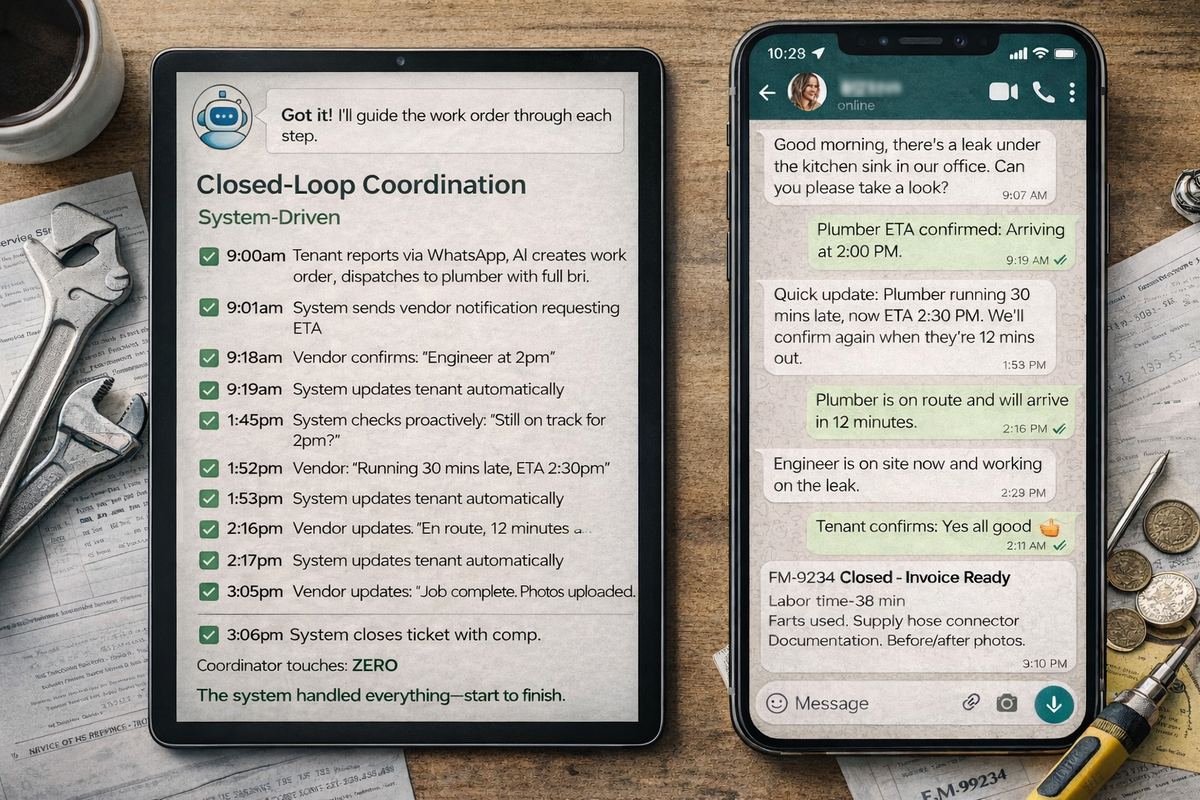
Closed-loop coordination (system-driven):
9:00am - Tenant reports via WhatsApp, AI creates work order, dispatches to plumber with full briefing
9:01am - System sends vendor notification requesting ETA
9:18am - Vendor confirms: "Engineer at 2pm"
9:19am - System updates tenant automatically
1:45pm - System checks proactively: "Still on track for 2pm?"
1:52pm - Vendor: "Running 30 mins late, ETA 2:30pm"
1:53pm - System updates tenant automatically
2:16pm - Vendor updates: "En route, 12 minutes away"
2:17pm - System updates tenant automatically
2:29pm - Vendor: "On site, working on issue"
3:05pm - Vendor updates: "Job complete. Photos uploaded."
3:06pm - System receives completion data (photos, notes, time on site, parts used)
3:07pm - System requests tenant confirmation
3:09pm - Tenant confirms: "Yes all good"
3:10am - System closes ticket with complete documentation
3:11pm - Invoice data prepared and ready
Total coordinator touches: ZERO
Total coordinator time: 0 minutes
Outcome quality: HIGHER (complete documentation, photo evidence, tenant confirmation, invoice-ready)
That's closed-loop. The system didn't just dispatch the job. It owned the outcome through completion, handling every coordination touchpoint that would normally consume coordinator time.
The difference isn't magic. It's proactive orchestration instead of reactive coordination.
The system asks for what it needs, when it needs it, and doesn't accept "done" without proof.
Reopen cycles: the hidden coordination tax
Let me talk about a metric that doesn't get enough attention in FM operations: reopen rate.
Reopen rate = tickets that get marked "complete" but then have to be reopened because the issue wasn't actually resolved.
Industry research suggests the average reopen rate across facilities management operations ranges from 18-25%[^5], though this varies significantly by operation type and maturity of quality control processes.
Think about what that means. One in five tickets that you thought were done... aren't done. They come back. And when they come back:
- Tenant is frustrated (they thought it was fixed)
- Coordinator has to investigate what happened (why wasn't it actually completed?)
- Vendor relationship is strained (did they lie about completion? Did they do poor work?)
- SLA has now been breached (ticket sat "closed" while issue remained)
- Rework costs money (second dispatch, second labor charge, parts waste)
According to a study by the British Institute of Facilities Management (BIFM), rework and revisits account for approximately 15-20% of total maintenance costs in commercial facilities[^6].
I spent time with a facilities team in Birmingham tracking their reopens for one month:
Total tickets closed: 1,240
Tickets reopened: 267 (21.5%)
Reasons for reopening:
- 38% - Vendor marked complete but issue persists
- 29% - Issue temporarily fixed but recurred within 48 hours
- 18% - Wrong issue addressed
- 11% - Tenant never confirmed resolution, assumed it was fine, then discovered it wasn't
- 4% - Parts failed or work was incomplete
Cost analysis per reopen:
- Coordinator time to investigate and re-dispatch: 22 minutes average
- Vendor time for second visit: 45 minutes average
- Tenant frustration calls: 8 minutes average
- Total: ~75 minutes of wasted effort per reopen
267 reopens × 75 minutes = 20,025 minutes = 334 hours = 2.1 FTE of wasted capacity per month
The team had three full-time coordinators. They were spending 70% of one person's entire capacity just dealing with reopens.
When they implemented closed-loop coordination with mandatory completion verification:
New reopen rate after 8 weeks: 7.2%
That's a 67% reduction in reopens. Which freed up 223 hours per month (1.4 FTE) that could be redeployed to proactive work like vendor relationship management, preventive maintenance coordination, and SLA optimization.
The magic wasn't better vendors. Same vendors. Same buildings. Same issues.
The magic was verification before closure. The system wouldn't let tickets close without:
- Vendor providing completion notes and evidence
- Tenant confirming issue resolved (or automatic confirmation if tenant doesn't respond within 24 hours)
- Mandatory photos for certain job types (electrical work, plumbing repairs, HVAC maintenance)
Finally, "done" actually meant done.
Where most implementations fail: half-measures
Here's the pattern I see in most "helpdesk automation" implementations:
Phase 1: AI helps create tickets from messages (saves 2 minutes per ticket)
Phase 2: AI suggests vendor based on category (saves 30 seconds per ticket)
Phase 3: Stop there and wonder why ROI is underwhelming
The problem? You've automated the easy 5% and left the hard 95% on humans.
Research from Gartner indicates that by 2028, 33% of enterprise software will include agentic AI capabilities[^7], but current implementations often fall short of true end-to-end automation, focusing instead on point solutions that address individual tasks rather than complete workflows.
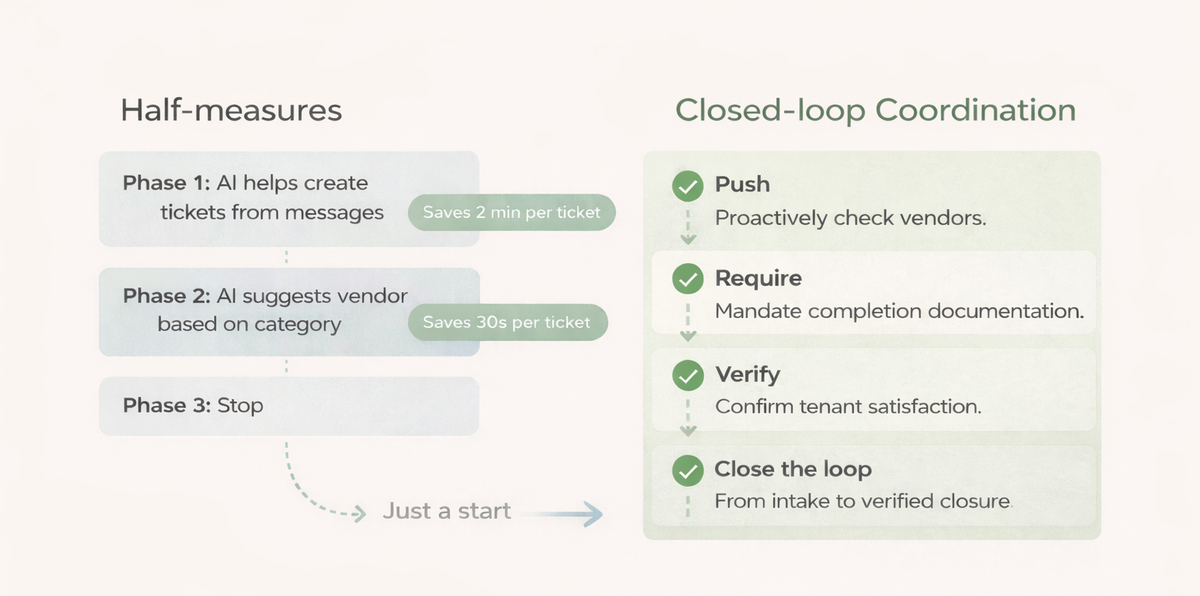
Real closed-loop coordination requires the system to:
- Push, not just respond (proactive vendor checks, not waiting for updates)
- Require, not suggest (mandate completion documentation, not hope for it)
- Verify, not assume (confirm tenant satisfaction, not just vendor completion)
- Close the loop completely (from intake to invoice-ready, not just dispatch to "in progress")
If your "automation" still requires coordinators to chase vendors, check on progress, request closure notes, and manually reconcile invoices... you haven't closed the loop. You've just digitized parts of it.
The economics are simple (but often invisible)
Let's do the math on what closed-loop coordination actually saves:
Scenario: 1,200 tickets per month, 2 full-time coordinators
Current state (dispatch-only automation):
- Average 3.7 follow-ups per ticket
- 8 minutes per follow-up
- 1,200 × 3.7 × 8 = 35,520 minutes = 592 hours/month of chasing
- Coordinator capacity: 320 hours/month
- Shortfall: 272 hours/month (manifests as overtime, burnout, missed SLAs)
With closed-loop coordination:
- Average 0.4 follow-ups per ticket (only exceptions requiring human judgment)
- Same 8 minutes per follow-up
- 1,200 × 0.4 × 8 = 3,840 minutes = 64 hours/month
- Hours saved: 528 hours/month = 3.3 FTE capacity reclaimed
Annual impact:
- Overtime elimination: £12K (based on average UK FM coordinator overtime rates[^3])
- Capacity to handle 50% more volume with same team: £45K value
- Reduced reopen rework: £18K (based on BIFM rework cost estimates[^6])
- Total annual value: £75K
Investment in closed-loop AI: £18-24K/year
Net savings: £51-57K/year
Payback period: 3-5 months
These figures align with broader industry findings. A 2025 McKinsey report on AI in facilities management found that organizations implementing comprehensive workflow automation saw average labor cost reductions of 40-60% in helpdesk operations[^8].
Closed-loop isn't a feature. It's a mental model.
The shift from dispatch automation to closed-loop coordination isn't about adding more AI capabilities. It's about changing what you expect the system to do.
Old mental model: "The system helps coordinators work faster"
New mental model: "The system owns outcomes, coordinators handle exceptions"
Old expectation: "AI creates tickets, coordinators manage them"
New expectation: "AI manages tickets end-to-end, coordinators approve exceptions and build vendor relationships"
Old success metric: "Time to create work order"
New success metric: "Coordinator hours per 100 completed tickets"
This is why industry analysts have started calling it "agentic AI" instead of "automation." Because automation suggests you're speeding up tasks. Agentic means you're delegating outcomes[^7].
When you dispatch a vendor, you're not just routing a ticket. You're delegating an outcome: "Make sure this gets resolved and properly closed."
Most systems dispatch and hope.
Closed-loop systems dispatch and verify.
That verification—the chasing, the confirming, the documenting—is where 60-70% of coordinator time goes[^4].
And that's what needs to be automated.
Not the dispatch. The entire loop.
___________________
Sources & Further Reading
[^1]: International Facility Management Association (IFMA). (2024). "Facility Management Forecast 2024: Time Allocation and Operational Efficiency."
[^2]: Based on HeyFixit analysis of work order data from 12 UK facilities management deployments between Q3 2024 and Q1 2025, tracking 22,000+ service requests across commercial office portfolios.
[^3]: UK Office for National Statistics (ONS). (2024). "Average Earnings and Overtime in Facilities Management Sector." Labour Force Survey data.
[^4]: JLL. (2024). "The Future of Facilities Management: Technology, Talent, and Transformation." Global Real Estate Perspectives Report.
[^5]: Facilities Management Journal (FMJ). (2023). "Work Order Management Best Practices: Measuring Quality and Completion Rates."
[^6]: British Institute of Facilities Management (BIFM). (2023). "The True Cost of Reactive Maintenance: Understanding Rework and Revisits in FM Operations." \
[^7]: Gartner. (2024). "Predicts 2025: Agentic AI Will Transform Enterprise Software." Gartner Research Report ID G00812847.
[^8]: McKinsey & Company. (2025). "AI-Powered Operations in Commercial Real Estate and Facilities Management."
Additional Industry Resources:
- Facilities Management Association (FMA) - Annual FM Technology Survey
- CBRE Research - "The State of Facilities Technology 2024"
- Verdantix - "Green Quadrant: Facilities Management Software 2024"
- Deloitte - "The Future of FM: Digital Transformation in Property Operations":
- McKinsey - "The State of AI"
__
Next in this series: How AI agents earn trust in facilities operations—the governance frameworks, approval workflows, and audit trails that make autonomous coordination safe for compliance-critical environments.
Title image by Austin Distel on Unsplash.
Frequently asked questions
Closed-loop does not mean the ticket got closed. It means the system owns the outcome from request to verified completion, with minimal human intervention. It handles vendor acknowledgment, access and ETA management, progress tracking, completion verification and closure documentation, so a job only counts as done when there is proof: notes, photos and tenant confirmation, not just a vendor saying so.
Because dispatch is the easy part. Assigning a ticket to a vendor takes about 30 seconds, but the follow-up loop after it consumes 6 to 12 minutes per ticket, repeated across hundreds of tickets a month. That is where coordination cost hides. Research by IFMA finds facility managers spend around 45% of their time on administrative and coordination tasks, and a JLL study puts coordination and communication as high as 60%.
Reopen rate is the share of tickets marked complete that have to be reopened because the issue was not actually resolved. Industry research puts the average at 18 to 25%. Every reopen means a frustrated tenant, a coordinator investigating what went wrong, a strained vendor relationship, a breached SLA and rework cost. Mandatory verification before closure is what brings it down.
In one facilities team that added mandatory completion verification, the reopen rate fell from 21.5% to 7.2% after eight weeks, a 67% reduction that freed about 223 hours a month. The better yardstick is coordinator hours per 100 completed tickets rather than time to create a work order, because that is where the real capacity is won back.

Vibha Ramprakash
Co-Founder, CMO/COO
Vibha has spent four years building technology for real estate and asset management operators. Today she works directly with FM leaders across the UK and UAE on the challenges that sit between good technology and the people who have to use it every day.
LinkedIn