Jul 24, 2026
•Updated on Jul 24, 2026
•10 min read
What Goes Into an Operations and Maintenance (O&M) Manual?
An operations and maintenance manual is the handover document that records a building's assets and how to maintain them: PPM schedules, certificates, warranties and shutdown procedures. It only stays useful if kept current, so treat it as a live record from day one, not a box of PDFs.

Vibha Ramprakash
Co-Founder, CMO/COO
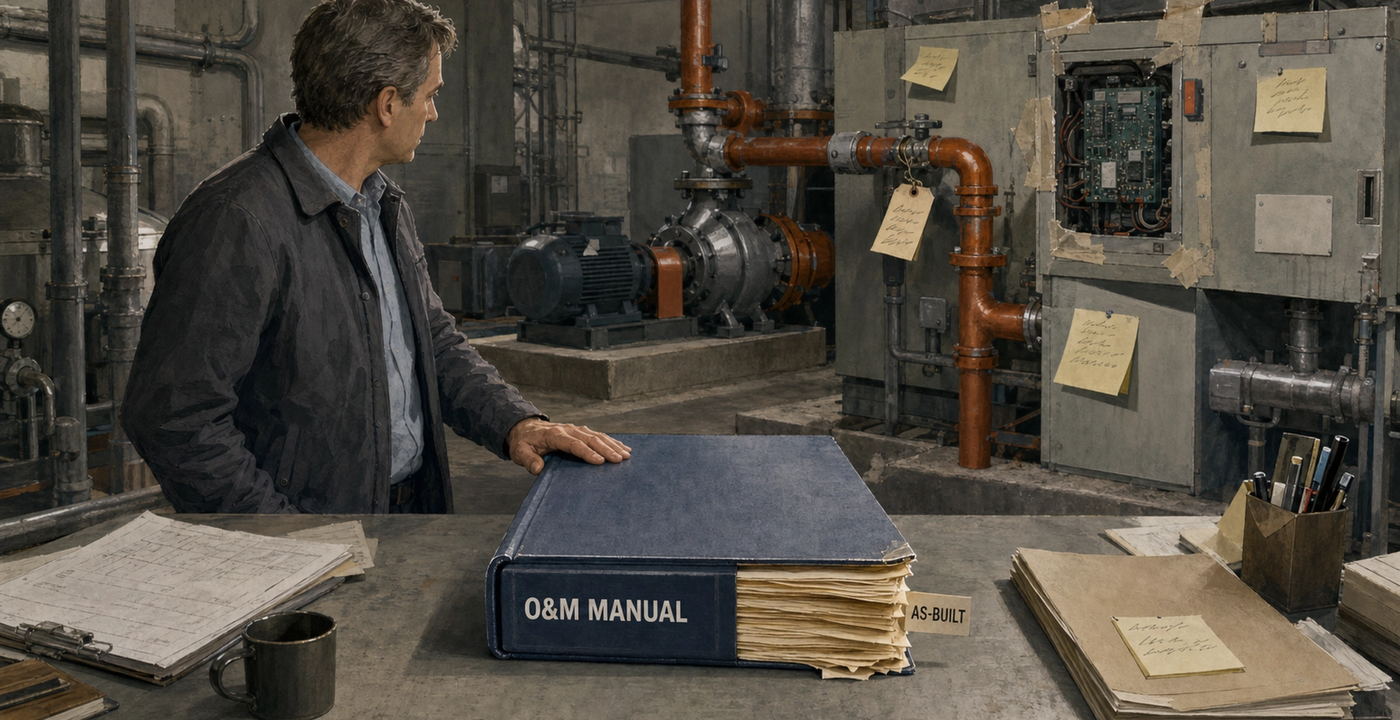
An operations and maintenance manual is the handover document that records what is in a building and how to look after it: every asset that was installed, how each one works, how often it needs maintaining, and who to call when it fails. The contractor compiles it and hands it to the estates team on the day the building goes live, and from that morning it is meant to be the single reference for running the place.
The decay starts the next morning. A pump gets swapped, a valve gets isolated for a leak, a warranty gets called in, and none of it finds its way back into the book. Within a year the manual describes a building that has quietly moved on without it, and the estates manager has stopped trusting a word of it.
What is an O&M manual?
An O&M manual, short for operations and maintenance manual, is the compiled set of information a building's constructors hand over so the people who inherit the building can operate and maintain it safely. It is the building's instruction book. Every serviceable asset, its specification, its maintenance regime, its warranties and the procedure for shutting it down in an emergency, gathered into one place and handed across at practical completion.
In UK construction it is a defined handover deliverable, not a courtesy. The estates or CAFM team uses it to build the planned maintenance programme, to respond when something breaks at 2am, and to prove the building was compliant on the day it opened. Done well, it is the difference between inheriting a building you understand and inheriting one you have to reverse-engineer, asset by asset, the first time each one fails on you.
What goes into an O&M manual?
There is no single legal template, but a complete operations and maintenance manual almost always carries the same eight things. Read the list as the building's operating kit, the minimum an engineer who has never set foot in the place would need to keep it running.
- As-built drawings and specifications. What was actually installed, floor by floor and system by system, rather than what the original design drawings intended. On a refurbishment the gap between the two can be wide.
- The asset register. Every maintainable asset listed with its make, model, serial number, location and installation date. It is the spine the rest of the manual hangs off.
- Planned maintenance schedules. The PPM regime for each asset: what gets inspected, serviced or replaced, and how often. This is the part that should be a working plan, not a static appendix, from the first week.
- Statutory test and inspection certificates. Gas safety, fixed-wiring, lifting equipment, fire and emergency lighting: the certificates that prove the building met its legal duties at handover.
- Warranties and guarantees. What is covered on each asset, for how long, and the maintenance conditions that quietly void the cover if you miss a service.
- A spare-parts and supplier directory. Part numbers, consumables and the suppliers who hold them, so an engineer is not trying to identify a filter from a photograph at 7am.
- Emergency, isolation and shutdown procedures. How to make each system safe quickly: where the stopcocks, isolators and main valves are, and the order to hit them in.
- A contact and responsibility directory. Who designed and installed each system, who maintains it now, and who to phone when it fails out of hours.
The planned maintenance schedule is the part that dates fastest, which is why it belongs in a live tool from the first week rather than a PDF appendix, the same discipline behind what a 52-week PPM planner actually tracks. Larger projects hand a good deal of this over digitally rather than in a lever-arch file. COBie, the Construction Operations Building Information Exchange standard folded into the National BIM Standard-US (2015), drops the asset register, warranties, spare-parts lists and maintenance schedules into a structured file the CAFM system can read directly.
Who produces the O&M manual, and when?
On most UK projects the principal contractor owns the manual. Under the Construction (Design and Management) Regulations 2015, the principal contractor and principal designer are responsible for pulling together the information the client needs to operate and maintain the finished building, and the manual is where a large part of that information lands. Subcontractors feed in the detail for their own systems, a consultant or the contractor's own team compiles it, and it is handed across at or near practical completion.
The recognised guidance on how to do it well is BSRIA's BG 79/2020, Handover Information and O&M Manuals, which replaced the long-standing BG 1/2007 and ties the manual to the building's actual maintenance strategy rather than a generic contents list (BSRIA, 2020). It leans heavily on the Soft Landings process: the idea that the people who will run the building stay involved through design, construction and a period after handover, so the manual reflects how the estate will really be operated. The client who insists on that involvement gets a manual written for operators. The client who does not gets a lever-arch file nobody opens twice.
One thing the manual is not is the health and safety file. That is a separate document required under CDM 2015, carrying the residual risks anyone needs to know before doing future work on the building. The two travel together at handover and get confused constantly, but they do different jobs, and the FAQ below pulls them apart.
Why most O&M manuals are out of date within a year
Here is the part the ranking pages skip. An O&M manual is a photograph taken on handover day. It is an accurate, detailed picture of the building at one moment, and the building never stays in that moment. Assets get swapped for different models, control settings drift, a chiller gets a warranty repair, a contractor replaces a part with whatever was on the van that morning. The photograph does not update itself.
So where does the real, current state of the building actually live? Not in the manual. It lives scattered across the CAFM system, the inboxes where jobs were agreed, the service reports filed by half a dozen different contractors, and the heads of the engineers who did the work. The manual promises to be the single source of truth. The truth is spread across a dozen places, and no single record holds all of it.
Picture the estates manager three years in, standing in front of an air-handling unit that has failed for the third time. The manual lists the original unit and its original service regime. It does not know about the two control-board swaps, the impeller replaced under warranty, or the strategy a contractor rewrote one weekend to stop nuisance trips. All of that happened; none of it is written down where she can find it. She is making a repair-or-replace call on a machine whose real history exists only as fragments in other people's records.
It rots for a boring, human reason, not a technical one. Keeping the manual current is coordination work, and coordination work is the first thing dropped when a desk is buried. Engineers log jobs thin: a two-hour repair goes down as two minutes on site, the problem and resolution codes are left blank, the asset that was actually changed never gets named. In our interviews with multi-site FM leaders, roughly 90% of contractor engineers don't follow the full CAFM process on a job. On an estate closing three hundred reactive jobs a month, that leaves well over three thousand completed repairs a year whose real detail never reaches a permanent record, let alone the manual.
This is not a filing nuisance, it is a maintenance-management problem. BS 8210:2020, the UK code of practice for facilities maintenance management, treats asset information as something to be kept current as a managed activity, because a maintenance decision is only as good as the record it runs on (BSI, 2020). When that record is a year-old photograph, the estate cannot answer the questions that actually pay: is it cheaper to repair this asset again or replace it, what has this plant really cost across five years, where should next year's capital go. Every one of those is a repair-versus-replace or a whole-life-cost question, and every one needs a history the manual stopped keeping the week after it was written.
The instinct is to blame the CAFM, but the software is usually excellent. It is a behaviour problem. Every completed work order is meant to leave a trace on the asset it touched, and most of them simply do not. That gap between what the system could hold and what people actually feed it is why facilities management is entering its self-driving era, and it is the same gap that leaves the O&M manual frozen on the day it was signed off.
How often should an O&M manual be updated?
The honest answer is continuously, not annually. An O&M manual should change every time the building does: when an asset is replaced or added, when a PPM frequency is revised, when a statutory certificate is renewed, and when a warranty is used or lapses. A yearly review is a sensible backstop for catching what slipped through, but a manual touched only once a year is a manual that is wrong for eleven months of it.
The practical problem is ownership. At handover the manual passes to the client, and with it the duty to keep it current, but that duty rarely lands on a named person with the hours to do it. The fix is not a bigger annual review. It is capturing each change at the moment it happens, as part of the job that caused it, so the record becomes a by-product of the work rather than a separate chore nobody gets to. A manual maintained that way is never more than a day out of date. A manual maintained by good intentions is out of date by the first weekend.
What it looks like when the record updates itself
Everything above holds whether or not you change a single system. You could keep an O&M manual perfectly current by hand, updating the register, the schedules and the certificates every time a job closes. It is just that this is exactly the work that gets dropped first when the desk is busy, which is why so few manuals survive their first year intact.
At Heyfixit we put AI agents on that coordination work, capturing a complete record of each job at source, in the channels engineers and contractors already use, as the work happens. The engineer's confirmed finding is what updates the asset record, so the history the O&M manual was supposed to hold is actually captured, and it stays current because it is a by-product of the job rather than a form somebody has to remember to fill in afterwards. The asset register self-heals through the normal run of work instead of ageing quietly on a shelf.
3,500+ hours
saved annually per Heyfixit implementation
Here is the honest boundary. This is a coordination layer on top of the CAFM you already run, not a replacement for it, and not a document system that rewrites your manual for you. The agents assemble, capture and chase; they never make the maintenance judgement calls, and predicting a failure from a sensor is a different job we don't claim. Judgment stays human. What changes is that the record your manual depends on stops depending on anyone remembering to update it. If your handover documents are already drifting away from the building they describe, see how Heyfixit keeps the asset record complete as the work happens.
Frequently asked questions
An operations and maintenance manual is the handover document that explains what is in a building and how to maintain it. It lists the installed assets, their specifications, the planned maintenance each one needs, the warranties, the statutory certificates and the emergency shutdown procedures, all in one place. The contractor compiles it and hands it to the client at practical completion. Its job is to let the estates team run and maintain the building without working everything out from scratch. In practice it is only as useful as it is current, which is why keeping it up to date matters as much as compiling it well in the first place.
A complete O&M manual usually contains eight things: as-built drawings and specifications, the asset register, planned maintenance schedules, statutory test and inspection certificates, warranties and guarantees, a spare-parts and supplier directory, emergency and isolation procedures, and a contact and responsibility directory. Larger projects also hand over a digital version through COBie so the data drops straight into a CAFM system. There is no single legal template, so the exact contents flex with the building. The test of a good manual is simple: could a new engineer who has never seen the building keep it running from the manual alone? If not, something important is missing.
On most UK projects the principal contractor is responsible for producing the O&M manual, with subcontractors supplying the detail for their own systems and a consultant or the contractor's team compiling it. Under the CDM 2015 regulations the principal contractor and principal designer must pull together the information the client needs to operate and maintain the building, and the manual carries much of it. It is handed over at or near practical completion. Once it changes hands, responsibility for keeping it current passes to the client, usually the in-house estates or facilities team. That handover of ownership is where a lot of manuals quietly stop being maintained.
They are two separate documents that travel together at handover. The O&M manual tells the facilities team how to operate and maintain the building day to day: assets, schedules, warranties and procedures. The health and safety file, required under CDM 2015, is narrower and safety-focused. It records the residual risks that anyone planning future construction, cleaning, maintenance or demolition work needs to know about, such as where hazardous materials sit or how a structure is designed to be taken down. The manual is for running the building. The file is for keeping people safe during future work on it. Good practice keeps them distinct, not merged.
Continuously, not once a year. The manual should be updated every time the building changes: when an asset is replaced, when a maintenance frequency is revised, when a statutory certificate is renewed, and when a warranty is used or lapses. An annual review is a useful safety net for anything that slipped through, but it is not a substitute for keeping the record current as work happens. BS 8210:2020, the UK code of practice for facilities maintenance management, treats asset information as something to be maintained as an ongoing activity. The most reliable approach is to capture each change at the moment of the job that caused it, so the manual stays a working record rather than a historical one.

Vibha Ramprakash
Co-Founder, CMO/COO
Vibha has spent four years building technology for real estate and asset management operators. Today she works directly with FM leaders across the UK and UAE on the challenges that sit between good technology and the people who have to use it every day.
LinkedIn