Jun 24, 2026
•Updated on Jun 24, 2026
•10 min read
Wear and Tear vs Disrepair: What Tenants and Landlords Actually Owe
Disrepair is deterioration that drops a rental below the standard a landlord must legally maintain; normal wear and tear is what ordinary living leaves behind. The catch: most disputes aren't about the definition, but about who has a dated record of the property's condition to prove it.

Vibha Ramprakash
Co-Founder, CMO/COO

Disrepair means a property has fallen below the condition its landlord is legally required to keep it in: deterioration or damage that needs fixing, not the gentle fading of ordinary use. To define disrepair plainly, it's a fault a reasonable person would call broken, unsafe, or unfit. Normal wear and tear is the opposite end of the same scale, the marks any tenant leaves behind by living there. Landlords owe repairs. Tenants owe damage. The line between them decides who pays.
The trouble almost always starts at move-out. A managing agent walks a two-bedroom unit in Columbus with a stained carpet, a scuffed hallway, and a tenant who swears it looked that way on move-in day. The landlord wants a deduction from the deposit. Nobody wrote down what move-in day actually looked like, so both sides argue from memory, and memory is not evidence.
What disrepair actually means
Every landlord-advice page draws the same line: disrepair is the landlord's problem, wear and tear is nobody's bill. That's correct, and it's usually where the guide stops. The definitions are worth getting exact, though, because the words carry real legal weight on both sides of the Atlantic, and the standard is not identical in the US and the UK.
In the United States, the anchor is the implied warranty of habitability. It applies in most states whether or not the lease mentions it, and it requires the landlord to keep a rental safe and livable: working plumbing and heat, sound structure, no code violations, and no infestation the tenant didn't cause. When those fail, you have disrepair, and the landlord owes the fix no matter what the tenancy agreement says. A lease clause that tries to push those repairs onto the tenant is generally unenforceable.
In England and Wales the line is drawn by statute. Section 11 of the Landlord and Tenant Act 1985 makes the landlord responsible for the structure and exterior and for the installations that supply water, gas, electricity, sanitation, and heating, and a landlord cannot contract out of it. The Homes (Fitness for Human Habitation) Act 2018 went further, adding a fitness standard a tenant can sue on directly. Housing disrepair, in the UK sense, is precisely this: the property has dropped below that statutory line and the landlord hasn't put it right in reasonable time.
Normal wear and tear is the mirror image. The US Department of Housing and Urban Development, in Handbook 4350.1 REV-1 (1996), describes it as deterioration that results from the intended use of the dwelling: faded paint, carpet worn thin in the traffic path, a door that's been opened ten thousand times. It happens to every unit whether the tenant is careful or reckless, and you can't charge anyone for the passage of time. Disrepair and damage are faults someone is responsible for. Wear and tear is a fault nobody is.
It helps to notice that disrepair and damage point in opposite directions. Disrepair is a claim a tenant makes against a landlord who let the home slip below standard. Damage is a claim a landlord makes against a tenant who broke something. People lump them together as condition problems, but they run on different legal tracks, and the same crack in the same wall can trigger either one depending on how it got there. That's why the cause of a fault matters more than the fault itself.
Wear and tear vs disrepair: which side each item falls on
The clearest way to see the line is by asset, because the same object can sit on either side depending on what happened to it. A carpet worn flat along the hallway is wear and tear. The same carpet with a cigarette burn or a pet stain is damage. Here's how the common items usually split, with usually doing real work, because the criteria in the next section can move almost any row.
| Asset or area | Normal wear and tear (landlord absorbs) | Disrepair or damage (chargeable or repairable) | Who usually pays |
|---|---|---|---|
| Walls and paint | Faded paint, minor scuffs, small nail holes from pictures | Crayon or graffiti, large holes, unapproved paint colors | Wear: landlord. Damage: tenant |
| Carpet and flooring | Thin patches in walkways, light matting, minor fading | Burns, pet stains, gouged or water-damaged boards | Wear: landlord. Damage: tenant |
| Appliances | A fridge or boiler that fails after years of normal use | A unit broken by misuse or a tenant repair gone wrong | Wear or age: landlord. Misuse: tenant |
| Heating and plumbing | Aging pipes, a worn washer, gradual limescale | A cracked radiator from a hard knock, a drain blocked by what shouldn't go down it | Failure: landlord. Damage: tenant |
| Doors and windows | Sticking hinges, worn seals, sun-bleached frames | A forced lock, a cracked pane, a kicked-in panel | Wear: landlord. Damage: tenant |
| Fixtures and surfaces | Loose handles, tarnished taps, a worn worktop finish | Chips, burns, and breakages from an accident or neglect | Wear: landlord. Damage: tenant |
Notice the pattern under the table. Wear and tear is what time and ordinary use do to a place. Damage is what a specific event or a specific person does. Tenant wear and tear, the everyday scuffs and fading, stays with the landlord as a cost of doing business. Damage and neglect follow the tenant to the deposit.
What tips wear and tear into damage
So how do you actually move a row from one column to the other? Three tests decide it, and nearly every deposit dispute turns on at least one of them.
~5 years
HUD useful-life standard for rental carpet, after which its chargeable value is effectively zero
U.S. Department of Housing and Urban Development, HUD Handbook 4350.1 REV-1, 1996
- Age against expected lifespan. Everything wears out on a schedule, and once an item is past its useful life its remaining chargeable value is effectively zero. HUD's useful-life standards, set out in HUD Handbook 4350.1 REV-1 (1996), are the reference most US managing agents reach for: roughly three years for interior paint, about five for carpet, ten to fifteen for major appliances. Charge a tenant the full price of a seven-year-old carpet they stained and you're billing for a carpet that legally had nothing left to lose. Prorate to the years remaining, or don't charge at all.
- Maintenance history. A failure a landlord could have prevented with routine upkeep is disrepair, not tenant damage. A boiler that dies because it was never serviced is the landlord's problem. A boiler a tenant disabled is the tenant's. The record of what was maintained, and when, is the only thing that reliably tells those two apart after the fact.
- Tenant behavior. The legal test is reasonable use. Deterioration from living normally is wear and tear. Deterioration from negligence, accident, or abuse is damage. A scuffed floor is use. A bathroom flooded by a tub left running is not, and the difference is the tenant's conduct, not the size of the repair bill.
What a landlord can actually charge for
Even when something is genuinely tenant damage, the landlord rarely gets to bill the full replacement cost. The governing idea in both markets is betterment: a tenant shouldn't have to hand back a property in better condition than they received it, and a landlord shouldn't profit from a claim. So a damaged five-year-old carpet with two years of life left is worth those two years, not a brand-new floor. Deductions come off the deposit, and normal wear and tear can't be deducted at all, because it was already priced into the rent. This is where most over-charging happens: landlords bill new-for-old, tenants dispute it, and without a dated inventory and a maintenance record the adjudicator sides with whoever brought evidence. The paperwork decides the money.
A practical example. A tenant burns a two-year-old kitchen countertop. New-for-old, that's a full replacement bill. Under betterment and useful life, the landlord recovers the depreciated value of the remaining lifespan, and only if a move-in record shows the countertop was undamaged to begin with. No record, no charge that survives a challenge.
The fight is never really about the definition
Here's where the advice pages and I part ways. Read enough of them and you'd think tenants and landlords clash because they don't understand the definition. They do. Ask any managing agent and they'll recite the wear-versus-damage line in their sleep. The fight is almost never about what the words mean. It's that nobody has a timestamped record of the property's condition to check the claim against.
Watch how the argument actually runs. The tenant says the carpet was stained on move-in. The landlord says it was spotless. There's a move-in inventory somewhere, maybe, filled out in a hurry, no photos, no date stamp anyone trusts. The definition is now useless, because you cannot apply a definition to a condition nobody captured. Both sides argue from memory, and the deposit goes to whoever argues hardest or whoever the adjudicator happens to believe.
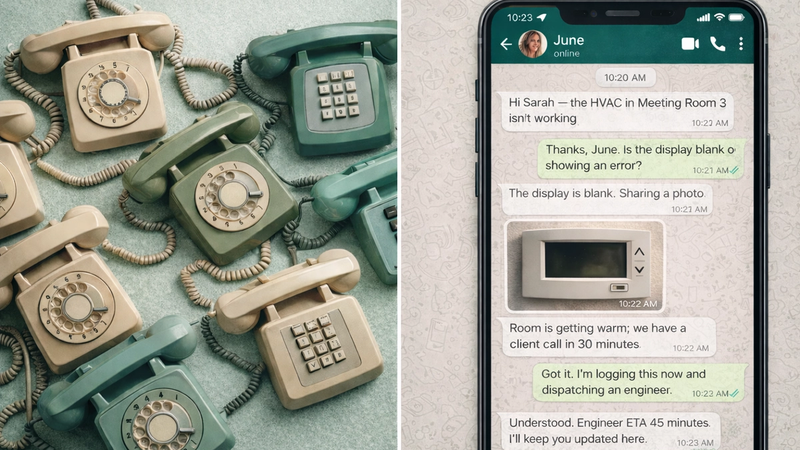
The same gap runs right through the tenancy, not just its end. A tenant reports damp. Someone sends a contractor. The contractor says it's fixed. In our interviews with multi-site FM leaders, 80–90% of requesters never verify that a repair actually resolved the problem; they close the ticket on the contractor's word. Six months later the damp is back, now with a disrepair claim attached, and there's no record of what was found, what was done, or whether the fix ever held. And the channel a tenant reports on decides whether you capture anything usable in the first place.
The cost isn't only the disputed deposit. A managing agent's real expense is the hours spent adjudicating fights that a two-minute dated photo at move-in would have ended, the goodwill burned with a tenant who feels robbed, and the landlord who blames the agent for a deposit they couldn't defend. Every one of those traces back to the same missing artifact: a record of what the place looked like, and when.
This is the insider truth the top-ranked pages skip. Wear-and-tear disputes are not a knowledge problem. They're an evidence problem. A property changes hands, gets repaired, degrades, and gets repaired again, and at almost none of those moments does anyone capture what it actually looked like in a form that survives an argument later. This is the quieter half of what AI in property maintenance is really for: not just doing the repair faster, but recording it as it happens.
Your property system logs that a job was closed. It doesn't log the condition it was closed in. That gap is exactly what an AI workforce for facilities management is built to close, and we'll get to how in a moment. But the evidence problem is worth naming on its own terms first, because it's real whether or not you ever automate a thing.
Closing the evidence gap
So what actually fixes this? Not a sharper definition. A better record.
Heyfixit is an AI workforce that runs the coordination around property maintenance: it answers the tenant, logs the fault, dispatches the contractor, chases the visit, and verifies the work got done, all on top of the property system you already run. On the disrepair question specifically, condition gets captured as it happens, the reported fault carrying a date and the tenant's own words, the contractor's report validated against what was actually asked for, photos and timestamps attached to the job instead of buried in someone's phone. When completion is verified against the job's own trail instead of taken on trust, the record a deposit dispute or a housing disrepair claim needs already exists, built at the moment the work happened rather than reconstructed from memory a year later.
The value runs past winning arguments. Managing agents who move this coordination onto agents instead of coordinators report a 50–60% reduction in helpdesk labor costs, because the chasing and the writing-up stop landing on a human desk.
The honest boundary: we don't decide who's liable. An agent will never rule that a stain is damage or that damp is the landlord's fault. That's a judgment call, and judgment stays human. What the agents do is assemble the timestamped evidence trail, so the person making the call works from a record instead of a hunch.
If your disrepair disputes keep coming down to memory versus memory, that's the gap worth closing. See how the coordination runs.
Cover image by Luke van Zyl on Unsplash.
Frequently asked questions
Disrepair means a property has deteriorated below the condition the landlord is legally required to keep it in. It covers faults that make a home unsafe, unfit, or broken, like failed heating, damp, leaks, or structural damage. It does not cover the gradual wear that comes from living somewhere normally. In the US the standard comes from the implied warranty of habitability. In England and Wales it comes from Section 11 of the Landlord and Tenant Act 1985 and the Homes (Fitness for Human Habitation) Act 2018. When a property falls below that line, the landlord owes the repair.
Housing disrepair is the UK term for a rented home that has fallen below the legal standard its landlord must maintain. It usually refers to problems like damp and mould, broken heating, leaks, faulty wiring, or structural defects that the landlord has failed to fix within a reasonable time. Tenants can bring a housing disrepair claim to force repairs and sometimes recover compensation. The key point is that the fault must be the landlord's responsibility under the tenancy or by statute, not damage the tenant caused. Wear and tear does not count as disrepair.
Normal wear and tear is deterioration from ordinary, reasonable use over time, like faded paint, thin carpet in walkways, or a worn door hinge. Damage is deterioration from negligence, accident, or misuse, like a burned countertop, a pet-stained carpet, or a hole punched in the wall. The simplest test is cause. If time and everyday living did it, it is wear and tear and the landlord absorbs it. If a specific event or careless act did it, it is damage and the tenant is usually liable. Age and the item's expected lifespan then decide how much a landlord can actually charge.
The landlord pays for normal wear and tear. It cannot legally be deducted from a tenant's deposit, because it is the expected cost of renting the property out. The tenant pays only for damage beyond normal wear and tear, and even then only for the item's remaining useful life, not a brand-new replacement. So if a tenant damages a carpet that was already most of the way through its lifespan, the landlord can charge the leftover value, not the cost of a new one. Anything charged as wear and tear can be challenged and usually reversed.
You prove it with a timestamped record of the property's condition at each point in time. That means dated, photographed inventories at move-in and move-out, plus a maintenance and repair history showing what was fixed and when. Disrepair shows up as a fault the landlord failed to maintain. Tenant damage shows up as a change between move-in and move-out that ordinary use cannot explain. Without those records both sides argue from memory and the outcome turns on who is more convincing. The party with dated evidence almost always wins, which is why capturing condition as it happens matters more than knowing the definitions.

Vibha Ramprakash
Co-Founder, CMO/COO
Vibha has spent four years building technology for real estate and asset management operators. Today she works directly with FM leaders across the UK and UAE on the challenges that sit between good technology and the people who have to use it every day.
LinkedIn