Jun 19, 2026
•Updated on Jun 19, 2026
•10 min read
Property Maintenance: What It Includes, Who's Responsible
Property maintenance covers everything that keeps a building's systems and common areas working, but who pays for a repair depends on whether you're the tenant, landlord, HOA, or managing agent. Here's the breakdown by task, and why fixed and verified aren't the same claim.

Vibha Ramprakash
Co-Founder, CMO/COO
Property maintenance means keeping a building's structure, systems, and shared spaces in working order: the roof, the boiler, the parking lot lights, the fire door that has to close properly. It spans routine upkeep, planned repairs, and the reactive fix when something breaks. What it doesn't automatically answer is who pays for it, because that depends on the task, the lease, and who signed up to coordinate it.
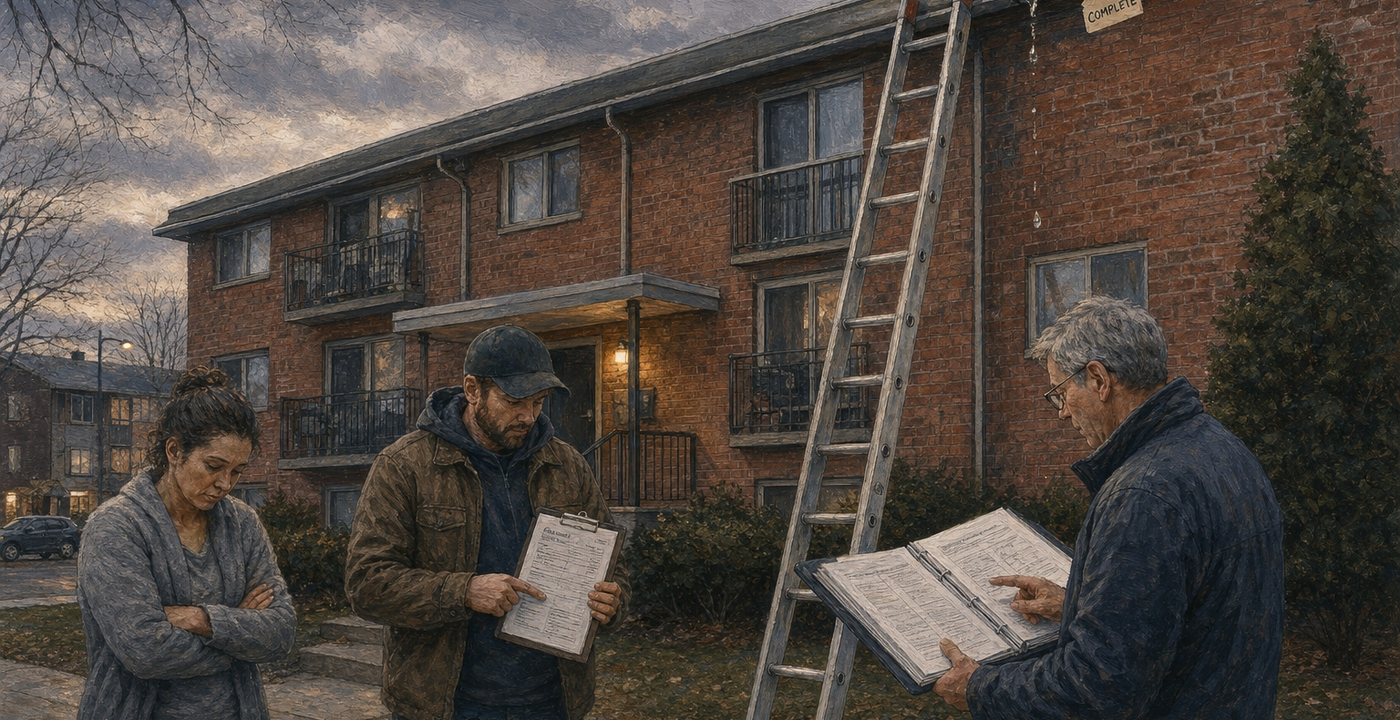
A gutter comes loose on a third-floor unit in a Denver HOA building. The tenant reports it to the property manager. The property manager assumes the HOA's exterior contract covers it. The HOA assumes it's the owner's downspout, not the shared roofline. Three weeks and two more rainstorms later, someone finally climbs a ladder.
What property maintenance actually includes
Property maintenance breaks into three buckets, and most checklists only name the first one.
Routine and planned upkeep is the PPM side: filter changes, gutter clearing, fire alarm testing, landscaping on a schedule, HVAC servicing before the season it matters. This is the maintenance a lease or management agreement usually spells out by name.
Reactive repair is everything that shows up as a request: a leak, a broken lock, an HVAC unit that stops in July. This is where most of the coordination labor actually goes, because a reactive request has to be logged, assigned to the right trade, and chased to a finish, not just scheduled.
Compliance and life-safety work sits on top of both: fire door checks, elevator certification, legionella testing on water systems, electrical safety checks. It is maintenance with a paper trail attached, because a missed compliance task is a liability question, not just a comfort one.
Commercial property maintenance adds a fourth layer most residential checklists skip: common-area maintenance (CAM), the landscaping, parking lot, exterior lighting, and shared-system upkeep that gets billed back to tenants under a triple-net lease, prorated by square footage. It is still property maintenance; it just gets invoiced differently.
The three buckets also carry three different coordination costs. Planned work gets scheduled once and mostly runs itself. Reactive work has to be caught, understood, and routed every single time, which is why a building with a thorough PPM calendar can still feel chaotic: the schedule was never the hard part.
| Task category | Tenant | Landlord / owner | HOA / managing agent |
|---|---|---|---|
| Interior fixtures & appliances | Reports issues, minor upkeep | Repairs or replaces if not tenant-caused | Not involved (inside the unit) |
| Plumbing, electrical, HVAC systems | Reports, doesn't self-repair | Repairs and maintains | Shared risers and systems only |
| Structure & roof | Not involved | Owns it if there's no association | Owns it if it's a shared structural element |
| Common areas & grounds | Not involved | Owns it if there's no association | Owns it, bills back via dues or CAM |
| Emergency / habitability (heat, water, life-safety) | Reports immediately | Must respond fast, usually a legal duty | Coordinates response for shared-system failures |
Who's responsible: tenant vs landlord vs HOA vs managing agent
The table above is the general rule. Three things override it in practice:
- Age and cause: a five-year-old water heater that fails on its own is the owner's problem; the same unit damaged by a tenant leaving a window open in freezing weather usually isn't.
- The governing documents: for anyone inside a homeowners association, the CC&Rs (covenants, conditions, and restrictions) or bylaws are the actual contract, not the state's general landlord-tenant code.
- Emergency status: it changes the clock, not the ownership column. A no-heat call in January gets a same-day response regardless of whose line it sits on above; a loose cabinet hinge doesn't.
That second point matters more than most checklists let on. Roughly one in four Americans, about 78.1 million people, now live inside a community association (Foundation for Community Association Research, 2025). For a huge share of the US housing stock, "who's responsible" is answered by a private document most residents have never read, not by general property law.
If you manage UK leasehold blocks, the same split runs under different names: the freeholder, or the block's managing agent acting for them, typically owns structure, roof, and common parts; leaseholders own everything inside their own demise; the service charge, the UK's version of CAM, funds the shared side. The lease, not a generic checklist, is still the actual source of truth.
That Denver gutter from the opening got fixed, eventually, but only because the property manager finally pulled the HOA's CC&Rs and found the roofline named as a shared element. Nobody needed a new policy. They needed the document they already had, read at the right moment instead of after three weeks of back-and-forth.
What a property maintenance coordinator actually does day to day
The job title suggests scheduling. The actual day is mostly chasing.
A property maintenance coordinator, in-house, or working for a managing agent covering a dozen buildings, takes in requests from every channel a resident or tenant will actually use: a phone call, an email to the front office, a text to the super, occasionally a portal nobody wanted to log into. Each one gets triaged, matched to a vendor or an in-house tech, and then chased, because a work order created is not a work order started.
In our interviews with multi-site FM leaders, triage and assignment alone run 5 to 10 minutes per ticket, and the full coordination cycle for one job, from intake to a vendor actually showing up, runs 30 to 40 minutes of active human time. None of that is the repair. All of it is finding out who's free, confirming they're licensed for the building's insurance requirements, getting a time window that works for the resident, and then following up when the vendor doesn't show.
At ten buildings and even a modest ticket volume, that coordination time is the job. The trades themselves barely touch the coordinator's calendar; the phone calls and the status-chasing do.
Channel fragmentation makes it worse. A tenant who calls Monday and emails again Wednesday because nobody replied isn't being difficult; they're doing what anyone does when a request seems to have vanished. Without one place where every channel lands, the coordinator ends up doing duplicate triage on the same issue reported twice, which eats the very time that should have gone to the next ticket.
The gap between "maintained" and "verified"
Every property maintenance checklist assumes the story ends when the technician leaves. It usually doesn't.
80–90%
of people who raise a maintenance request never verify the fix actually held
From our interviews with multi-site FM leaders
In our interviews with multi-site FM leaders, 80 to 90 percent of people who raise a maintenance request never actually verify the fix. They don't call back to confirm the leak stopped, they don't check that the lock now catches, they just notice the ticket went quiet and assume it's done. The property manager or coordinator marks the job closed because the vendor said so, not because anyone independently checked.
That gap matters more than the task list does. A "maintained" building, on paper, is one where every ticket eventually closes. A "verified" building is one where someone can show the fix actually held. Those are different claims, and most property maintenance programs only make the first one.
It shows up worst on recurring issues: a leak "fixed" three times in a year that keeps coming back because nobody confirmed the root cause the first time, only that a technician was dispatched. It shows up in disputes too. When a tenant says a repair was never actually done and the landlord says it was, the honest answer is usually that nobody knows, because nobody checked and wrote down what they found.
Why the maintenance record rarely matches what actually happened
Ask any managing agent to pull a clean maintenance history on a five-year-old unit and watch how long it takes.
CMMS and property-management software are usually the system of record, but the record is only as good as what gets typed into it, and the people doing the typing are the same people rushing to the next call. A two-hour repair gets logged as a fifteen-minute visit because nobody stopped to write it up properly on site. Problem and resolution codes get skipped because they slow the tech down. Contractors sometimes keep their own paper trail separate from the portal, because the portal is extra admin they're not paid for.
The consequence isn't just messy paperwork. It's that nobody trusts the maintenance record enough to use it for the decisions that actually matter: whether to replace an aging HVAC unit or keep repairing it, what a unit's true total cost of ownership has been, which buildings in a portfolio are quietly bleeding money on repeat call-outs. The checklist tells you maintenance happened somewhere. It rarely tells you enough to plan around.
This is why the same rooftop unit can get a repair-vs-replace decision wrong two years running. The record says three service calls; it doesn't say those three calls were the same failing compressor. Without that pattern showing up clearly, replacement gets deferred again, and the eventual capital request goes in with a weaker case than the actual history would have supported.
How property maintenance actually gets paid for
Pricing follows the same split as responsibility, and it's worth learning to read a property maintenance services contract closely before you sign one.
Routine, scheduled work almost always runs on a contract: a flat monthly or annual rate for landscaping, HVAC servicing, fire safety testing, the tasks that happen on a calendar whether or not anything's broken. Reactive work is usually time-and-materials: a callout rate plus parts, billed as it happens, because nobody can put a fixed price on how often things will break.
A property maintenance service that only does one of these two things is common, and worth checking for before signing anything: some outfits are strictly reactive-repair contractors, others hold PPM contracts and subcontract anything unplanned. Larger portfolios often run both at once, a maintenance company on retainer for the schedule, a bench of on-call trades for whatever the schedule didn't predict.
On commercial buildings, CAM charges add a third layer: tenants pay their prorated share of shared-area upkeep on top of whatever the landlord's own maintenance contract costs, which is why a commercial lease's CAM clause is worth reading as closely as the rent number.
Contract renewal is where a lot of this gets renegotiated, usually annually. That's the moment to check whether last year's PPM scope still matches the building, whether reactive callout volume justifies moving a task from time-and-materials onto the schedule, and whether the service provider's response times actually held, not just what the contract promised on paper.
Where Heyfixit fits
Property maintenance software already tracks the states: request opened, assigned, in progress, resolved, closed. What most systems don't track is the work between those states: the chasing, the verifying, the writing down of what a tech actually found on site, and that's exactly where "maintained" quietly becomes "we think it's maintained."
Heyfixit sits on top of the CMMS or property-management software a portfolio already runs, not instead of it. Your work order states don't change; what changes is who does the work between them. Requests come in by phone, WhatsApp, or email and get triaged and routed the same day, at any hour. Vendors get chased to acknowledgment and to a named engineer, not just assigned and hoped for. When a job closes, the agent captures the completion evidence, photos, notes, a confirmed root cause, from the person who actually verified it, not just the technician's say-so. One multi-site FM provider running this model recovers 60 staff-hours a week at 98% SLA compliance.
What we don't do: we don't decide who's liable for a repair, and we don't sign off on safety calls. Those stay with your team, always; we just make sure the evidence exists when someone has to make that call.
If your portfolio's maintenance records are more checklist than truth, see how Heyfixit AI coordinates the work between every status.
Frequently asked questions
Property maintenance includes routine upkeep like filter changes, landscaping, and fire alarm testing, reactive repairs like leaks, broken locks, and HVAC failures, and compliance work like fire door checks, elevator certification, and water safety testing. On commercial buildings it also covers common-area maintenance: parking lots, shared lighting, and exterior grounds, usually billed back to tenants.
A property maintenance coordinator takes in requests from residents or tenants, decides which trade or vendor should handle each one, and chases the job through to completion. Most of the role is coordination, not repair work: matching, scheduling, and following up when a vendor goes quiet.
Commercial property maintenance covers the systems, structure, and common areas of a business property: HVAC, plumbing, roofing, parking lots, and shared lighting. Under a triple-net lease, tenants typically pay their share of these costs as common-area maintenance charges, prorated by square footage.
A property maintenance service is a company or team hired to handle upkeep and repairs on a property, either as a general contractor for reactive work or on a scheduled contract for routine tasks like landscaping and HVAC servicing. Some cover both; many specialize in one.
Most property maintenance pricing runs one of two ways: a flat monthly or annual contract for routine, scheduled work, or time-and-materials billing for reactive repairs as they come up. Larger portfolios often blend both, a PPM contract for planned work plus an hourly or per-call rate for anything unplanned.

Vibha Ramprakash
Co-Founder, CMO/COO
Vibha has spent four years building technology for real estate and asset management operators. Today she works directly with FM leaders across the UK and UAE on the challenges that sit between good technology and the people who have to use it every day.
LinkedIn