Jul 22, 2026
•Updated on Jul 22, 2026
•9 min read
Total Facilities Management (TFM): What It Actually Covers
Total facilities management means one provider delivering every hard and soft FM service under a single contract and one point of accountability. TFM consolidates the supplier and the invoice, not the coordination between a job's states, which is where estates keep losing time.

Vishak C Prakash
Co-Founder & CEO
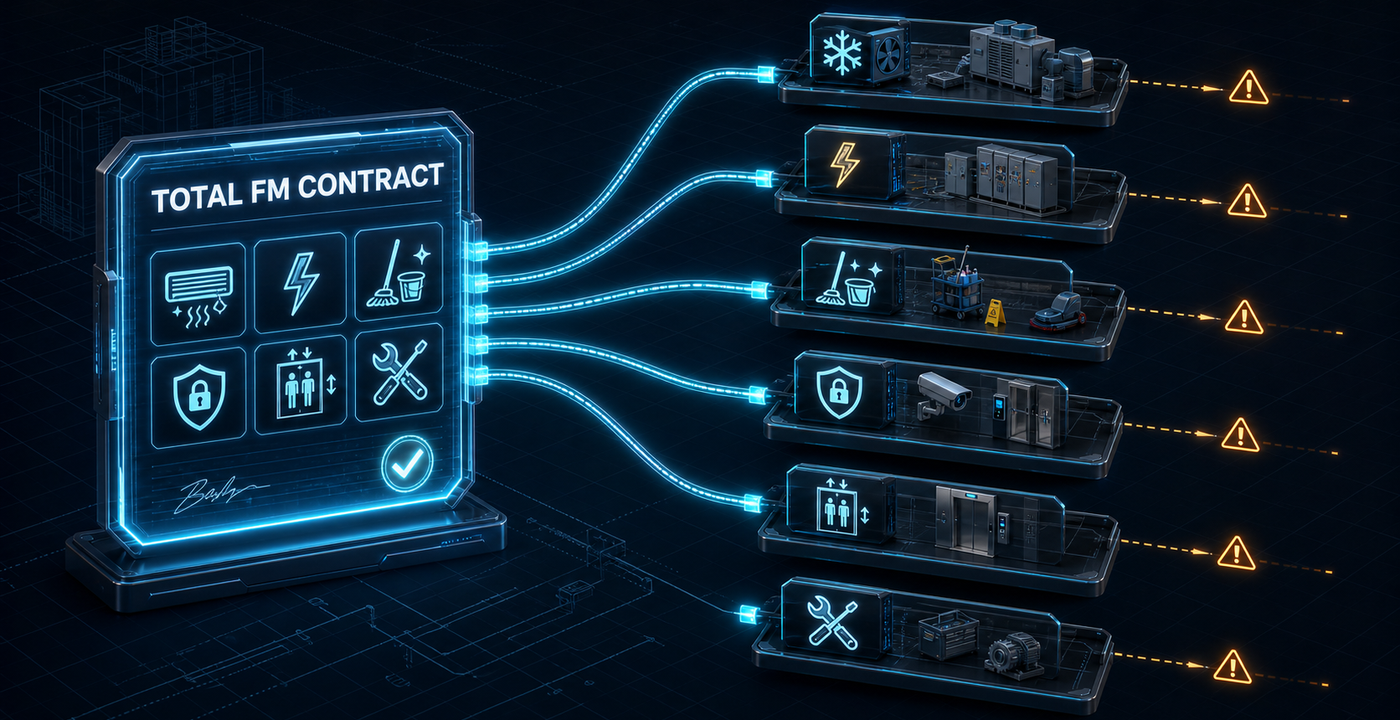
Total facilities management, or TFM, means handing every facilities service a building needs, the hard engineering side and the soft people-facing side, to a single provider under one contract. The pitch is simplicity: one supplier, one invoice, one number to call when something breaks. What a TFM contract genuinely consolidates is procurement. What it does not automatically consolidate is the day-to-day coordination that decides whether a building actually runs well.
An estates lead signs a TFM deal to stop juggling fifteen separate suppliers. Six months in, the cleaning is handled and the boilers are serviced on schedule, but they are still chasing the same question they always chased: did that reactive job actually get done, and can anyone prove it? The contract got simpler. The coordination did not.
What total facilities management actually covers
TFM is defined by its scope, not by any single task. It rolls up two broad families of service that most organisations otherwise buy piecemeal, and puts them under one provider and one contract.
Hard FM is the building and its systems: the engineering-led work that keeps the structure safe, compliant, and running. Soft FM is everything that makes the space usable and decent for the people in it. A TFM contract takes on both, plus the management layer meant to hold them together.
Hard FM typically covers:
- heating, ventilation, and air conditioning, plus the boiler and chiller plant behind them
- electrical systems, lighting, and standby power
- mechanical services, plumbing, and drainage
- fire and life-safety systems, lifts, and building access
Soft FM typically covers:
- cleaning, waste, and washroom services
- security, reception, and front-of-house
- grounds, landscaping, and pest control
- catering, vending, and general workplace support
If you want the full distinction between the two, we cover it in hard FM versus soft FM. For TFM the point is simpler: one provider is now accountable for all of it. The international standard for the discipline, ISO 41011, defines facilities management as the function that integrates people, place, and process within the built environment to improve both quality of life and the productivity of the core business (ISO 41011, 2024). A TFM contract is one attempt to buy that integration off the shelf.
Bundled, integrated, total: three words that are not the same
These terms get used as if they mean the same thing. They do not, and the difference is exactly where TFM buyers get caught out.
A single-service contract buys one thing: just the cleaning, or just the HVAC. A bundled contract groups several services under one provider, but often runs them as separate operations that happen to share an invoice. Total, or integrated, facilities management goes further on paper: all services, one contract, one point of accountability. The industry itself splits the last hair. A bundled deal groups the services; an integrated one is meant to wire their systems, data, and processes together so they operate as one, not just bill as one.
That phrase, single point of accountability, is the whole sales pitch, and it is worth reading closely. It promises one provider who owns every outcome. What it delivers depends entirely on whether that provider has genuinely integrated the work underneath, or has simply become the single throat to choke while fifteen subcontractors carry on exactly as before. You can gain structure without gaining execution depth.
The coordination a single contract does not close
Here is the gap. A TFM contract consolidates the supplier and the paperwork. It does not, on its own, consolidate the coordination, the work that happens between the moment a job is raised and the moment it is verified closed. That work still lives where it always lived: in inboxes, on phones, and in the heads of a coordinator or two.
Every facilities system tracks the states of a job: logged, assigned, in progress, resolved, closed. Almost none of them track the work between those states, which is the part that actually consumes people. Bundling twelve services under one contract does not remove that work. It just puts all of it inside one provider's operation, where it is still done by hand.
And when it is done by hand, it is done unevenly. A portfolio that runs its coordination through a dozen subcontractors and a shared inbox will, sooner or later, pay for the same fault twice: one team logs a repair, another gets dispatched to the same symptom weeks later because nobody could see the first job. Consolidating the contract does not give anyone that visibility. Only consolidating the coordination does.
Take an estate that pushes three hundred jobs a month through a single total-FM contract, hard and soft combined. Each one still has to be logged, triaged, sent to the right engineer or subcontractor, chased, and checked. At around half an hour of coordination apiece, that is close to a full coordinator's month, every month, spent moving jobs between statuses, on a contract that was supposed to make all of that somebody else's problem.
This is why estates that consolidate their suppliers are often surprised that their own admin load barely moves. The provider changed. The manual middle did not. If you want the longer version of this argument, it is the same one behind why FM is entering its self-driving era.
Why the record stays thin under one provider
The second thing a TFM contract is supposed to buy you is a single, trustworthy picture of your estate: one provider, one dataset, finally an answer to repair-or-replace. It rarely arrives, and the reason is behavioural, not contractual.
The data in any CAFM system is only as complete as what people put into it, and people under time pressure put in the minimum. Engineers close a two-hour job with a two-minute note. Subcontractors keep their own records and treat the client's system as extra admin. Problem and resolution codes get skipped. None of that changes because the logo on the contract did. So the estate ends up with one provider and still cannot trust its own asset history enough to plan capital spend from it. Worse, a subcontractor often keeps two records of the same job, its own and the client's, and quietly prices that double entry into the rate. You end up paying for admin that still leaves your system half-empty.
There is even a management-system standard for getting this right. ISO 41001, published in 2018, sets out how to run a facilities function as one coherent, continually improving system rather than a stack of disconnected contracts (ISO 41001, 2018). But a standard describes the destination. Whether a TFM provider reaches it depends on whether the coordination underneath produces a complete record as a by-product of the work, or leaves the same gaps a fragmented supply chain left.
When total facilities management is the right call, and when it is not
TFM is a genuinely good fit for some estates and an expensive mismatch for others. The deciding factors are less about size than about how much internal capacity and control you want to keep.
It also helps to price the trade honestly. A management margin buys you a single point of contact and someone to coordinate the suppliers; it does not buy you a coordinated operation unless the provider can prove one. Judge that margin against what you would otherwise spend running the contracts yourself, not against a promised saving that quietly assumes the consolidation runs itself.
It tends to make sense when:
- you run a large or multi-site estate and no longer have the in-house team to manage many separate contracts
- your services are genuinely interdependent, so one accountable provider removes the finger-pointing between suppliers
- you would rather buy an outcome than manage a supply chain, and you have the commercial governance to hold one provider to it
It tends to disappoint when:
- you already have strong in-house FM and would be paying a management margin to hand over control you use well
- your estate is small enough that one or two direct contracts are simpler and cheaper than a wrapped-up deal
- you assume the contract itself will fix your data and coordination, rather than asking the provider to prove how it will
The honest test for any TFM pitch is not how many services the provider can bundle. It is whether they can show you, for a single job, the complete trail from the call that raised it to the evidence that closed it. If they can, the single point of accountability is real. If they cannot, you have bought a tidier invoice.
Making the single point of accountability real
Whether you run TFM, a bundle, or a stack of single-service contracts, the thing that decides how your buildings run is the coordination between a job's states, and that is exactly the part no procurement model fixes by itself.
At Heyfixit we put AI agents on that coordination work, on top of whatever CAFM and contract structure you already have. The agents answer and log jobs across phone, WhatsApp, and email, triage and dispatch them to the right resource, chase acknowledgements and reports, and verify that work was actually done before a job is allowed to close. The record fills in as a by-product, so the single dataset a TFM contract promises actually shows up.
50-60% reduction in helpdesk labour costs
across live Heyfixit deployments in the UK and UAE, 2026
The boundary stays where it should. The agents assemble, chase, and recommend; a human still approves spend, issues quotes, and makes the judgment calls. This is a coordination layer on top of your existing tools, not a replacement for them, and not a facilities-management contract. If your estate is weighing up total facilities management, it is worth knowing that the part that actually determines whether it works, the AI-run coordination between every work order's states, can be run properly whichever contract model you choose.
If you want to go deeper, we cover how AI agents work across the facilities lifecycle end to end, and what it takes to manage contractors well when the work is subcontracted out.
Frequently asked questions
In practice the terms overlap, and many providers use them interchangeably. The useful distinction is depth. Total facilities management usually describes the commercial model: every service, hard and soft, bundled under one contract and one provider. Integrated facilities management stresses that the underlying systems, data, and processes are wired together so the services operate as one, not just bill as one. A contract can be total on paper and barely integrated in practice. When you evaluate a provider, look past the label and ask how the services actually connect day to day.
Almost all of them. A TFM contract typically covers hard FM, which is the engineering side: heating and ventilation, electrical, mechanical and plumbing, fire and life-safety systems, lifts, and building access. It also covers soft FM, the people-facing side: cleaning, waste, security, reception, grounds, pest control, and catering. On top of both sits a management layer that plans the work, holds the subcontractors to account, and reports on it. The exact scope is negotiable, so read the schedule closely. What is in and out of the contract is where most disputes start.
It can be, but not automatically. Bundling gives one provider room to share staff across tasks and cut the overhead of running many contracts, which can lower cost. Against that, you pay a management margin for the provider to coordinate it all, and you lose some direct control over each service. For a large, multi-site estate with a thin in-house team, the savings usually win. For a smaller estate that already manages a few suppliers well, the margin can cost more than it saves. Price the management layer explicitly rather than assuming consolidation is cheaper.
Only if the provider actually captures it. The promise of one dataset is real in theory, because one provider touches every job. In practice the data is only as complete as what engineers and subcontractors record, and under time pressure they record the minimum. A two-hour job gets a two-minute note. Codes get skipped. So estates often consolidate suppliers and still cannot trust their asset history enough to plan capital spend. Ask a prospective provider to show you the full record of a single closed job. That tells you more than any dashboard demo.
When you already have strong in-house facilities management and use that control well, handing it to a provider for a margin can be a step backwards. It also rarely pays off for small estates, where one or two direct contracts are simpler and cheaper than a wrapped-up deal. And it disappoints anyone who expects the contract itself to fix poor data or coordination. A TFM provider can only run the work as well as its own systems and people allow. If those are weak, consolidating suppliers just moves the same problems under one roof.

Vishak C Prakash
Co-Founder & CEO
Vishak spent six years as a digital transformation consultant to facilities management and real estate operators across the UK, Middle East, Canada, and Australia — working with teams at CBRE, Siemens UK, British Land, and Brookfield. He now runs Heyfixit, building AI agents for facilities management.
LinkedIn