Jul 9, 2026
•Updated on Jul 9, 2026
•8 min read
Hard FM vs Soft FM: What's the Difference?
The difference between hard FM and soft FM comes down to risk: hard FM keeps a building safe and legally compliant, soft FM keeps it clean, secure and comfortable. Both run through one FM helpdesk, but only hard FM carries a statutory duty, and that changes who has to verify the work is really done.

Vishak C Prakash
Co-Founder & CEO

The split between hard FM and soft FM is simple to state. Hard FM is the maintenance of a building's physical fabric and engineering systems — heating, lifts, electrics, fire safety — while soft FM is the people-facing services that make it pleasant to occupy, like cleaning, security, and grounds. Hard services keep a building safe and legally compliant; soft services keep it comfortable. That is the definition every FM site gives you, and it is the easy part.
Here is what those lists miss. On a Tuesday morning your CAFM coordinator logs a failed lift and a complaint about the office plants in the same ten minutes, through the same inbox. One is a statutory-critical job with a legal inspection regime behind it. The other is a discretionary nicety. The intake channel treats them identically, and so, usually, does everything that happens after.
What falls under hard FM and soft FM?
Every UK FM services provider answers this with a list of trades sorted into two columns. That list is a fair starting point, so here it is. But it is sorted by the thing those lists usually leave out: the risk and statutory profile of each service, because that, not the trade name, is what should change how the job gets run.
| Service area | Hard or soft FM | Typical UK trades | Risk and statutory profile |
|---|---|---|---|
| Building services (M&E) | Hard FM | HVAC, boiler and chiller engineers, BMS | Statutory-critical: gas and electrical safety duties apply |
| Lifts and lifting equipment | Hard FM | Lift and escalator engineers | Statutory: LOLER thorough examination by a competent person |
| Fire and life safety | Hard FM | Fire alarm, sprinkler and extinguisher engineers | Statutory: a failed check is a legal and safety exposure |
| Cleaning and hygiene | Soft FM | Cleaners, washroom and waste services | Discretionary to contractual: comfort, image, hygiene |
| Security and front of house | Soft FM | Guarding, reception, concierge | Contractual, occasionally licence-driven |
| Grounds and landscaping | Soft FM | Gardeners and grounds teams | Discretionary: appearance and wellbeing |
Read down the last column and the real fault line appears. Hard FM clusters at the statutory end, where a missed job is a legal and safety problem. Soft FM clusters at the discretionary end, where a missed job is a comfort and image problem. Everything else about how these jobs get logged, dispatched, and closed tends to ignore that difference completely.
How to tell hard from soft FM: three tests
When a service sits on the boundary, three questions sort it faster than any trade list.
- Consequence of failure. If the job goes undone, is the result a legal or safety exposure, or a comfort and image problem? Danger points to hard FM.
- Statutory backing. Is there an Act or regulation behind the task with a defined inspection regime, or none? A named legal duty points to hard FM.
- Who signs it off. Does completion need a competent, certificated person, or is a satisfied occupant enough? A competent-person sign-off points to hard FM.
The current SFG20 standard, the schedule library UK teams plan maintenance against, formalises exactly this. It colour-codes every maintenance task by criticality, from statutory and legal at the top, through mandatory and optimal, down to discretionary (SFG20 maintenance criticality classification). The standard itself tells you these jobs are not equal. Most of what happens after the log does not.
What hard FM services actually buy you
Hard FM services buy you a building that is safe, legal, and running. That sounds obvious until you count how much of it is not optional. A commercial building with gas-fired plant needs an annual gas safety check by a Gas Safe registered engineer under the Gas Safety (Installation and Use) Regulations 1998. Passenger lifts and other lifting equipment need a thorough examination by a competent person, typically every six or twelve months, under the Lifting Operations and Lifting Equipment Regulations 1998. Fixed electrical installations carry their own periodic inspection duty. Miss one and the problem is not an uncomfortable occupant. It is an enforcement exposure with the HSE, and a liability question if something then fails.
This is why hard FM is where estates teams concentrate. The planned preventive maintenance regime is heavier, the paper trail gets scrutinised, and the cost of getting it wrong is measured in prohibition notices, not complaints. The trades are specialist and often certificated, so when a hard FM job is booked, someone qualified has to attend and someone qualified has to confirm it was done. In theory.
What soft FM services actually buy you
Soft FM services buy you a building people actually want to be in. Clean washrooms, a staffed reception, secure entrances, tended grounds. None of it holds the building up, and almost none of it carries a statutory duty, which is exactly why it gets treated as the flexible line in the budget. You can move a cleaning spec from five days to three. You cannot move a LOLER examination to whenever suits.
But discretionary does not mean unimportant, and it does not mean easy to manage. Soft FM is judged on things harder to pin down than a compliance certificate: is the space clean, does reception feel welcoming, are the grounds tidy? Because there is no legal backstop forcing a check, soft FM is the side where completion is most often assumed rather than confirmed. Nobody gets prosecuted for a cleaning job marked done that was only half done. They just get a building that quietly gets grubbier while the record says everything is fine.
There is a structural reason for that. Soft FM increasingly gets bought on output specifications rather than input ones: the contract asks for clean and presentable washrooms, not two hours of cleaning at 6am. Output specs are the right idea, but they only work if someone inspects the output against the standard. On the hard side a signed certificate is the proof the job happened; on the soft side the proof is a walk-round nobody quite has time to do. So the bucket with the least legal pressure to verify is also the one whose contract most depends on verification to mean anything, and that is a quietly expensive place to be lax.
The step both buckets skip: who verifies the work
Here is the gap the definition lists never reach. Hard FM and soft FM look like two different disciplines, and on the trade side they are. But in most estates they run through one coordinator and one system of record, logged through the same helpdesk inbox and chased with the same phone and emails, whether your team calls it a CAFM or a CMMS. The intake channel does not know or care whether the job is a statutory lift examination or a bin that did not get emptied.
That sameness is the problem, because the two jobs could not be less alike once you ask who confirms they were actually done. In our interviews with multi-site FM leaders, 80 to 90% of requesters never verify a completed job at all. Verification only happens when the outcome sits on someone's own targets. For a soft FM job that usually means nobody checks. For a statutory hard FM job it means the check that matters — was this really done, by someone competent, to the standard the law expects — is left to the same weak process that governs a missed bin.
The coordination itself is not free either. In our interviews with multi-site FM leaders, a single job takes five to ten minutes just to triage and assign, and 30 to 40 minutes of total coordination across its life. Take one estate logging fifty jobs a week across both buckets. At five to ten minutes just to sort and assign each one, before anyone picks up a tool, that is the better part of a working day every week gone on triage alone. That effort is identical whether the job is a fire-alarm fault or a flowerbed, and it all lands on the same helpdesk. Multiply it across a year and the coordination line, not the trades, is where the hours go, which is why what each of those tickets actually costs is worth knowing before you sign the next contract.
So the honest summary of the hard FM and soft FM split is not the trade list everyone leads with. It is this: two buckets with completely different risk profiles, run through one channel that treats them the same, and closed by a verification step that mostly does not happen. Fixing the trade list is not the opportunity. Fixing what happens after the log is.
Coordinating hard and soft FM without treating them the same
This is the part we work on at Heyfixit. AI agents run the coordination between a work order's statuses, answering, triaging, dispatching, chasing, and verifying, on top of the CAFM or CMMS your team already runs. The record stays where it is. As the spec puts it, your work order states don't change; what changes is who does the work between them. Both buckets still come through one channel, but they stop being treated the same after the log: a statutory hard FM job gets chased and its completion verified against the job's own audit trail and the certificate that proves it, while a discretionary soft FM job is coordinated to the standard its contract actually asks for. Same intake, different rigour, applied deliberately rather than by whoever happens to be free.
50–60% reduction
in helpdesk labour costs across live deployments in the UK and UAE
Heyfixit, 2026
The value shows up beyond the saved admin. Coordination labour comes off your team's desks, completion is verified instead of assumed, and the record is audit-ready because it was captured as the work happened, which matters most on exactly the statutory jobs where an inspector might ask. In live deployments across the UK and UAE, this has driven a 50–60% reduction in helpdesk labour costs.
The honest boundary: we are not a CAFM replacement, and we do not manage your statutory inspection cycle. Planning when the next gas check or LOLER examination falls due stays with your compliance regime. What we do is capture the certificate as completion evidence once the job is done, chase the ones still outstanding, and make sure a job marked closed can actually prove it. Judgment stays human throughout.
If the space between logging a job and knowing it was truly done is where your hard and soft FM effort disappears, see how the coordination layer works.
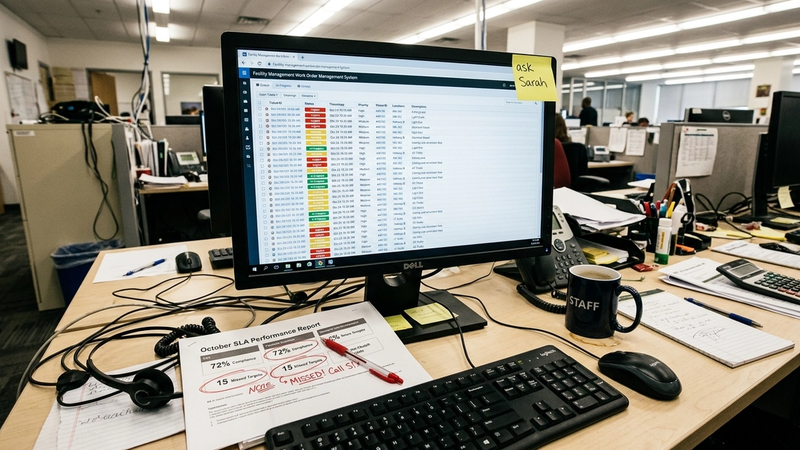
Cover image by Paramdeo Singh on Unsplash.
Frequently asked questions
Hard FM is the maintenance and management of a building's physical fabric and engineering systems. Think heating and ventilation, electrical installations, lifts, fire safety systems, plumbing, and the structure itself. These are the services that keep a building safe, compliant, and physically usable, which is why most of them carry legal duties behind them. Hard services are fixed to the building and cannot simply be switched off. If a boiler fails or a fire alarm faults, the job is not optional and often has a statutory inspection regime attached. That legal weight is the main thing separating hard FM from the softer, people-facing side of facilities management.
Soft FM covers the people-facing services that make a building comfortable, clean, and pleasant to occupy. Cleaning, security, reception, catering, waste, pest control, and grounds maintenance all sit here. Unlike hard services, soft services are not fixed to the building and rarely carry a statutory duty, so the level you buy depends on your budget, your occupants, and the impression you want to give. You can scale a cleaning contract up or down without breaking a law. That flexibility is the defining trait of soft FM. It is judged on comfort, image, and wellbeing rather than safety and compliance, which makes it easier to cut and easier to under-manage.
Hard FM services are the technical, building-fixed trades. The common ones are mechanical and electrical maintenance, heating and ventilation, air conditioning, lifts and escalators, fire detection and suppression, water hygiene, and fabric maintenance such as roofing and structural repairs. Most run on planned preventive maintenance schedules with reactive call-outs on top. A large share are statutory, meaning an Act or regulation sets how often a competent person must inspect them. Gas systems, electrical installations, and lifting equipment are clear examples. Because a missed hard FM service can create a legal and safety exposure, these are the contracts estates teams watch most closely and can least afford to let slip.
Soft FM services are the non-technical, people-facing services that support the occupants rather than the building. Cleaning and washroom services, security and guarding, reception and front of house, catering, waste management, pest control, internal plants, and grounds maintenance all count. They are usually delivered on a schedule or a service-level agreement rather than a statutory cycle, and they can be adjusted as needs and budgets change. The value is comfort, hygiene, safety of people, and the impression a space gives. Because soft FM rarely carries the legal weight of hard services, it is often the first place a facilities budget gets trimmed and the last place completion actually gets checked.
Often, yes. In a total facilities management setup, one in-house FM or estates team, or one outsourced provider, coordinates both buckets, and both usually arrive through the same CAFM system and the same helpdesk. That is the practical reality most definition lists skip. The person logging a failed lift is frequently the same person logging a cleaning complaint, through the same inbox, on the same afternoon. What changes between the two is not the intake channel but the stakes. A statutory hard FM job and a discretionary soft FM one carry completely different risk, yet the process behind them is usually identical. Separating how each is verified is where good coordination earns its keep.

Vishak C Prakash
Co-Founder & CEO
Vishak spent six years as a digital transformation consultant to facilities management and real estate operators across the UK, Middle East, Canada, and Australia — working with teams at CBRE, Siemens UK, British Land, and Brookfield. He now runs Heyfixit, building AI agents for facilities management.
LinkedIn