Mar 23, 2026
•6 min read
How Much Does an FM Helpdesk Cost Per Ticket? UK Benchmarks 2026
Most FM companies know their contract margins to two decimal places. Almost none of them know their cost per helpdesk ticket. For most, back-office coordination is quietly consuming 3.5–4% of contract revenue. Here's how to find your number — and what to do about it.

Vibha Ramprakash
Co-Founder, CMO/COO
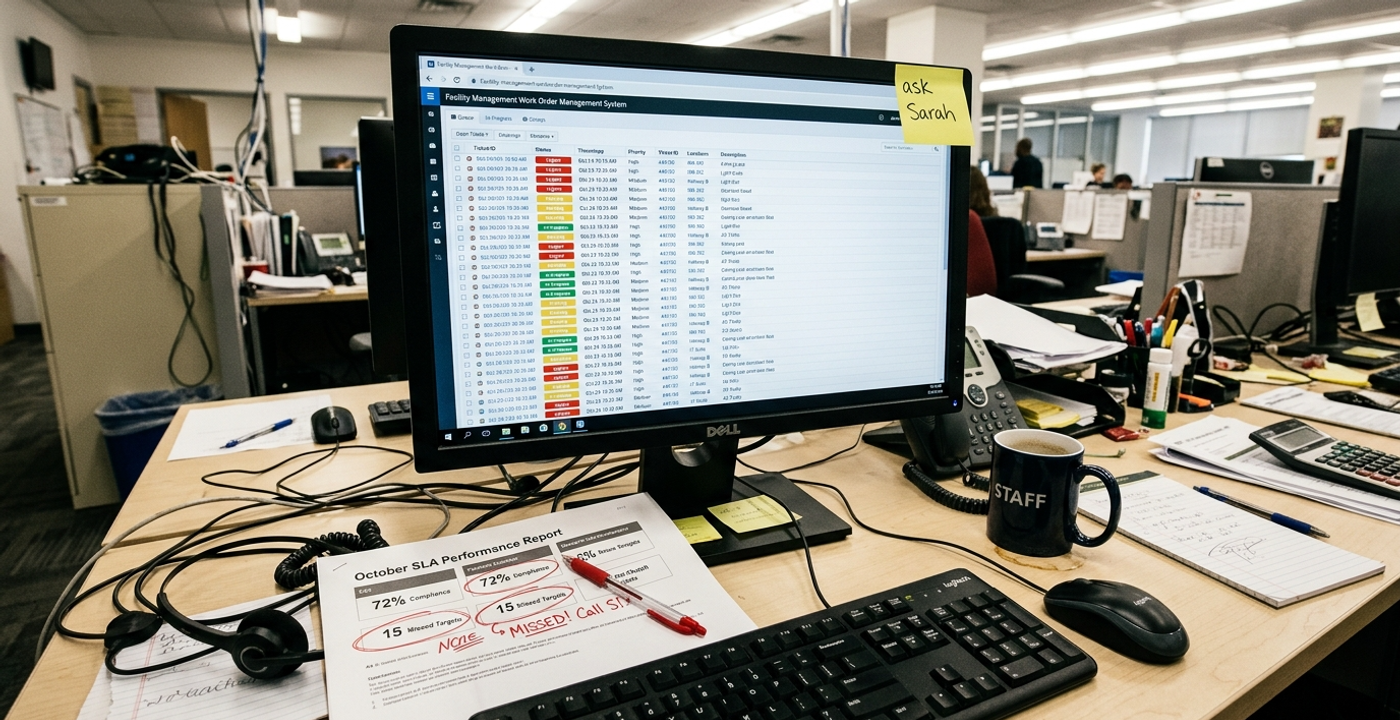
How Much Is Your FM Helpdesk Actually Costing You?
Most FM MDs don't know the number. Here's how to find it.
Facilities management is one of the few industries where the product is invisible until something breaks. Which means the back-office operation that keeps everything running — the helpdesk, the triage, the dispatch coordination, the tenant communication — rarely gets scrutinised with the same rigour as a contract bid or a technician utilisation rate.
That's a problem. Because for most FM companies, the helpdesk is quietly consuming 3.5–4% of contract revenue. On a £5m contract book, that's £175,000–£200,000 a year. Running on a 4–6% net margin.
Do that maths and you realise the helpdesk isn't a support function. It's eating half your profit.
The real cost of a single FM helpdesk ticket
Most FM companies think about helpdesk cost in terms of headcount. How many agents do we have? What are we paying them? But that calculation misses most of the actual cost.
A single FM helpdesk ticket doesn't just consume the time of the agent who takes the call. It touches intake — the call itself, triage, priority assignment, scope determination. Then coordination — contractor or technician identification, availability check, dispatch. Then communication — tenant acknowledgement, ETA confirmation, follow-up. Then administration — CAFM update, work order creation, closure confirmation. And then escalation — supervisor involvement for grey-area calls, out-of-scope decisions, priority overrides.
When you add all of that up, the fully-loaded cost of a single FM ticket in a UK mid-market company typically falls between £6 and £12 depending on complexity. For a company handling 3,000 tickets a month, that's £18,000–£36,000 in monthly back-office cost — before you account for the supervisory overhead layered on top.
The benchmarks that matter: the average fully-loaded cost per FM helpdesk ticket in the UK mid-market is £6.40. Back-office coordination consumes 3.5–4% of FM contract revenue. And 40–50% of ticket-handling time is spent on coordination and communication rather than resolution.
"The average FM helpdesk ticket costs £6.40 to process — fully loaded. At 3,000 tickets a month that's over £230,000 a year in back-office cost alone. On a 4–6% margin, that's not overhead. That's most of your profit."
Why the number is hard to find
If you've never sat down and calculated your cost-per-ticket, you're not alone. Most FM companies can't tell you the number because the cost is distributed across too many different heads.
The helpdesk agent's salary sits in one line. The supervisor's time — spent overriding priorities, handling escalations, answering questions that should have been in the SOP — sits in another. The CAFM licence is on a separate invoice. The contractor communication tool is on yet another. Nobody has ever added them up and divided by ticket volume.
This is exactly how overhead grows invisibly. Not through any single bad decision, but through the cumulative weight of manual processes nobody has been forced to cost.
The three cost drivers most FM companies don't track
The first is supervisor escalation rate. Every time a helpdesk agent needs a supervisor to make a call — on scope, on priority, on contractor selection — you're pulling a senior salary into a task that should have been handled at intake. If your escalation rate is above 5%, your SOP is incomplete. If it's above 10%, you're running your operation on tribal knowledge and hoping the right person is always available.
The second is priority inflation. Work orders logged at P1 that close at P3 represent real cost: the on-call callout fee, the after-hours technician rate, the premium contractor availability charge. If more than 20% of your P1 tickets are closing at P3 or lower, you're paying emergency rates for non-emergency issues. That's a triage problem — and it's costing you on every single misprioritised ticket.
The third is repeat contact rate. Every tenant who calls back because they didn't get an update, didn't get an ETA, or didn't understand the resolution is generating a second ticket for a problem that was already open. In companies without automated communication, repeat contact rates of 15–20% are common. Each one is a full ticket cost with no additional revenue.
"If your supervisor escalation rate is above 10%, your team is running on tribal knowledge — and hoping the right person is always in the building when something goes wrong."
How to calculate your own number
You don't need sophisticated analytics to get a working cost-per-ticket figure. Start here:
Take the total cost of your helpdesk team — salaries, employer NI, benefits. Add the fully-loaded hourly cost of supervisor time spent on helpdesk escalations (estimate 10–20% of a senior salary if you don't have the data). Add your CAFM licence cost, any telephony or ticketing tools, and contractor communication overhead. Divide by your monthly ticket volume.
That's your baseline cost per ticket. Benchmark it against £6.40. If you're above it, you have a process inefficiency. If you're significantly below it, check your assumptions — most companies that come in low have forgotten to include supervisor time.
What happens when you automate intake and triage
The parts of the helpdesk that are most expensive to run manually are also the parts most amenable to automation: intake, triage, priority assignment, contractor notification, and tenant communication.
FM companies that have automated these functions typically see a 35–45% reduction in cost per ticket through elimination of manual coordination steps, a 60–70% reduction in repeat contact rate through automated ETA and status updates, and near-elimination of after-hours on-call for non-P1 issues through structured triage that prevents priority inflation at source.
That's not a technology aspiration. That's what happens when the manual coordination layer is replaced by a system that handles intake, assigns priority based on objective criteria, notifies the right contractor, and keeps the tenant updated without human intervention.
The result isn't just cost reduction. It's margin recovery — on a contract book that was already thin.
"Automating intake and triage typically reduces cost per ticket by 35–45%. At 3,000 tickets a month, that's £6,000–£16,000 back on the table — every single month."
The question worth asking
Pull your last month's ticket volume. Estimate your helpdesk cost. Divide.
If the number is above £8, you have a recoverable problem. If the number is above £12, it's urgent.
The margin you're running on doesn't leave room for a helpdesk that costs more than it has to.
Frequently asked questions
The fully-loaded cost of a single FM helpdesk ticket in a UK mid-market company typically falls between £6 and £12 depending on complexity, and the average is £6.40. That covers intake, triage, coordination, tenant communication, administration and supervisor escalation, not just the agent who takes the call. For a company handling 3,000 tickets a month, that is £18,000–£36,000 in monthly back-office cost.
Because the cost is spread across too many separate lines. The agent's salary sits in one place, supervisor escalation time in another, the CAFM licence on its own invoice, and the contractor communication tool on yet another. Nobody adds them up and divides by ticket volume. Back-office coordination quietly consumes 3.5–4% of FM contract revenue, and 40–50% of ticket-handling time goes on coordination and communication rather than resolution.
Add the total cost of your helpdesk team, including salaries, employer NI and benefits. Add the loaded cost of supervisor time spent on helpdesk escalations, then your CAFM licence, telephony or ticketing tools, and contractor communication overhead. Divide by monthly ticket volume. Benchmark the result against £6.40. If you come in low, check whether you have left out supervisor time, which is the most commonly missed cost.
Yes. The most expensive parts to run manually, intake, triage, priority assignment, contractor notification and tenant communication, are also the most automatable. FM companies that automate these functions typically see a 35–45% reduction in cost per ticket and a 60–70% reduction in repeat contact rate through automated ETA and status updates. On a thin contract margin, that is margin recovery, not just cost reduction.

Vibha Ramprakash
Co-Founder, CMO/COO
Vibha has spent four years building technology for real estate and asset management operators. Today she works directly with FM leaders across the UK and UAE on the challenges that sit between good technology and the people who have to use it every day.
LinkedIn