Jul 21, 2026
•Updated on Jul 21, 2026
•9 min read
The Margin Leak Nobody Audits: Protecting Margins on Fixed-Price FM Contracts
Protecting margins on fixed-price FM contracts means closing three leaks: quote drag while the SLA runs, uplifts waved through on a verbal OK, and invoice lines nobody reconciles. In our interviews with multi-site FM leaders, unmanaged uplifts write off two to five percent of reactive revenue.

Vibha Ramprakash
Co-Founder, CMO/COO
On a fixed-price facilities contract, the price is locked but the cost is not. Protecting margins on fixed-price FM contracts is the work of keeping the money you quoted and the money you actually spend from drifting apart over the life of the job. That drift almost never arrives as one big overrun. It leaks, quietly, through three seams in the quote-to-invoice chain that nobody sits down to audit.
Picture a reactive job on a national retail contract. An engineer finds more wrong than the quote covered, phones your coordinator, gets a "yeah, go ahead," and fixes it. Three weeks later the subcontractor's invoice lands with an extra line, the coordinator half-remembers the call, the total looks about right, and it gets paid. That line was your margin.
Why fixed-price contracts leak margin even when you hit every SLA
The instinct, when a job comes in on time but the month comes in light, is to blame the original price. Sometimes that is fair. Far more often the price was fine and the money leaked during delivery. Across professional services, analysts estimate most organizations lose 15 to 20 percent of margin before they even detect the erosion, and the usual cause is not bad estimating but scope absorbed without a change order (Rocketlane, 2025).
In facilities the mechanism is more specific, and it is worth naming because none of the top-ranking pages do. The reconciliation that should catch the leak is assembled by facilities, not finance, and it is stitched together across three places that do not talk: the CAFM record, the subcontractor's invoice, and the phone-and-email trail where the job was actually agreed. Pulling those into line by line is slow, so it does not happen. Totals get checked. Lines do not. One FM leader put it plainly in our interviews: they might check the total amounts, but very rarely line by line.
So a job can hit its SLA, close clean on the dashboard, and still have handed back margin at the invoice. The SLA measures whether the work happened on time. It says nothing about whether you paid the right amount for it. Those are two different audits, and most providers only run the first one.
The three leaks in the quote-to-invoice chain
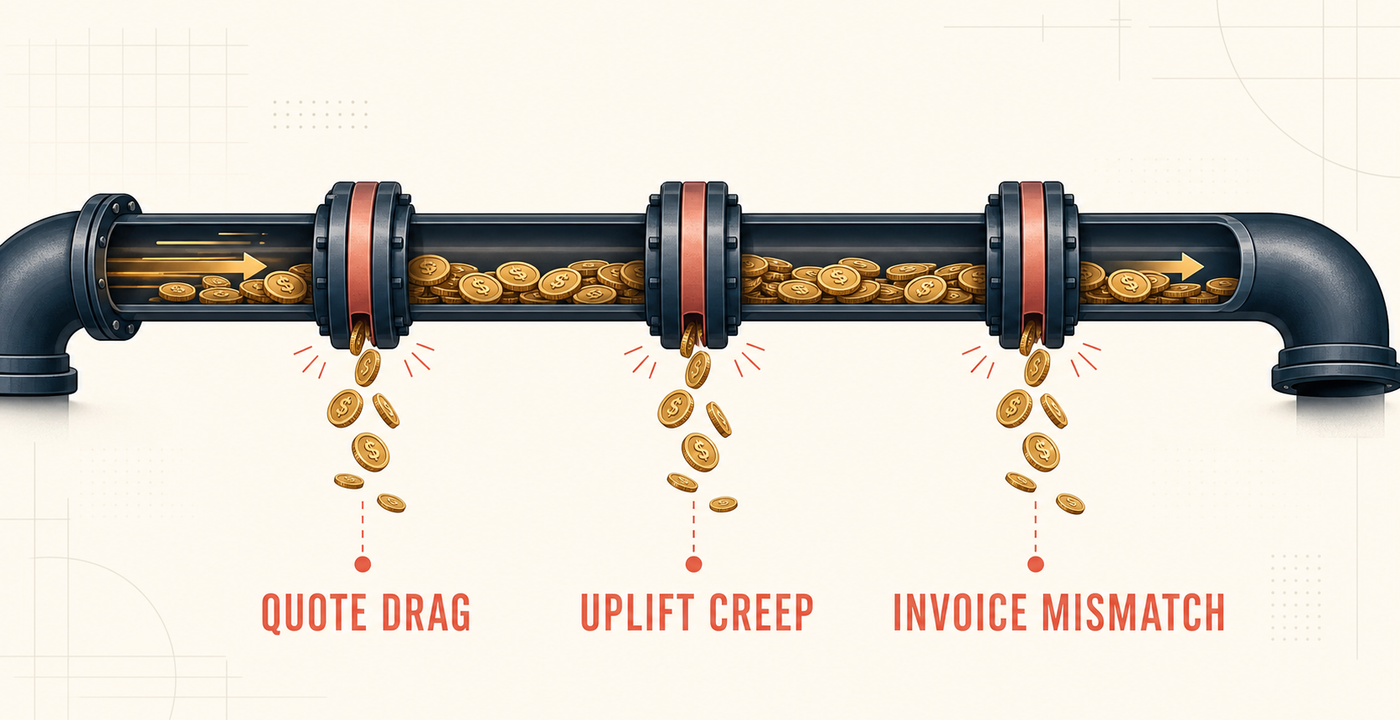
On reactive, fixed-price work the margin does not disappear in one place. It drains at three specific joints between the quote and the paid invoice. Name them and you can start watching them.
- Quote drag. Reactive jobs above the not-to-exceed limit need multiple quotes. Getting three comparable ones back takes five or six days, sometimes two weeks, and the SLA clock runs the entire time. The like-for-like comparison is manual, so the job sits in quote purgatory while penalty exposure builds and the pressure to just accept the first number grows.
- Uplift creep. Mid-job, the scope grows. The engineer is already on site, something else is clearly wrong, and the extra fix gets a verbal OK that nobody prices, evidences, or re-authorizes until the invoice turns up weeks later. This is the leak that, in our interviews with multi-site FM leaders, writes off roughly two to five percent of reactive revenue.
- Invoice-line mismatch. The final invoice gets checked on the total, not the lines. An uplift that was never approved, a rate that has drifted off the agreed schedule, a line for work the service report does not back up, all of it clears if the number at the bottom looks plausible.
Put a number on it. On four million pounds of reactive work a year, an uplift leak of two to five percent is somewhere between eighty and two hundred thousand pounds that never reaches a client invoice. That is not a rounding error, and it is not the odd expensive job. It is a steady write-off across hundreds of small ones that each looked fine on their own. On a fixed-price contract, every pound of it is yours to lose.
Quote drag: the leak that runs on the SLA clock
The first leak is the one that feels like diligence. You are getting competitive quotes, which is exactly what a well-run contract should do. The problem is the clock. Sourcing three genuine like-for-like quotes on a reactive job is a five-or-six-day exercise at best and a two-week one when a specialist trade is involved, and on a two-sided contract your SLA is running the whole time.
That is where drag turns into cost. Every day a job spends in quote limbo is a day of penalty exposure, and the longer it drags the more tempting it becomes to accept whatever quote landed first rather than the best one. The comparison that would have saved you money is the casualty of the deadline that is costing you money. Quote drag rarely shows up as a line in your accounts, but it sets up the two leaks that follow: a job accepted in a hurry is a job whose uplifts and invoice lines nobody has the appetite to fight later.
Uplift creep and scope creep are not the same leak
These two get treated as one problem and they drain margin differently. Scope creep is doing more work than the price covers and absorbing it without a change order. An uplift is a priced increase to a job that was already authorized, usually because the engineer opened something up and found more wrong than the quote assumed.
The dangerous case in facilities is an uplift that behaves like scope creep: real extra work, real extra cost, waved through on a verbal yes and never turned into an evidenced, re-authorized change before the money is spent. By the time it appears as a line on the subcontractor's invoice, the moment to price it and pass it to the client has passed. Catch an uplift at discovery, before the engineer does the work, and it stays billable. Catch it at the invoice, and it is usually an argument you have already lost. The difference between those two moments is the whole of the margin on that line.
The invoice line nobody reads
The last leak is the quietest, because it hides inside a task everyone assumes is being done. To actually verify a contractor invoice you need two matches, not one. Does each line match what was approved, the quote or purchase order? And does each line match what actually happened, the service report from the job? Only when both hold is the line real.
A busy facilities team rarely has both documents open at once, so it does the humanly reasonable thing and checks the total. If the total is close to what was expected, the invoice clears. That is precisely where an unapproved uplift or a drifted rate survives, tucked inside a plausible-looking total. The overpay is never a dramatic number. It is a line or two per invoice, on a fraction of jobs, repeated across a portfolio until it adds up to the margin you were sure you had priced in.
The dispute window is becoming a legal deadline, not a nicety
There is a reason line-level reconciliation is about to matter more than it ever has. The UK's late-payment reforms, confirmed in the government's consultation response in March 2026, introduce a 30-day window to dispute an invoice from the date you receive it. Miss the window and you are liable to pay in full. The same package caps standard payment terms at 60 days, with a stated intent to move toward 45, and makes statutory interest of eight percent above the Bank of England base rate a default in commercial contracts. The changes are expected to take effect no earlier than 2027.
Read that as a facilities provider and the consequence is blunt. Reconciliation stops being a back-office chore you get to when the month is quiet. If you cannot verify a line inside the window, you lose the right to dispute it, and the overpay becomes final. Quote-to-invoice reconciliation turns from a hygiene task into a hard commercial deadline, and the providers who can check lines quickly keep margin that the slower ones will simply forfeit by the calendar.
What it looks like when agents run the money chain
Everything above holds whether or not you change a single tool. Watching the three leaks, catching uplifts at discovery, matching invoices line by line, all of it is good practice you could staff by hand. The trouble is that it is exactly the work that gets skipped first when a coordinator is buried, which is why the leaks are so reliable.
At Heyfixit we put AI agents on that money chain, the coordination work between the quote and the paid invoice. On a reactive job the agents send requests to multiple vendors at once, chase the returns, and validate each quote line by line, then a human selects the winner. When scope grows on site, the uplift is flagged at discovery, evidenced, and held for re-authorization before the spend, not after. Every invoice is matched on both pairs, against the approved quote and against the service report, so a line that was never approved or never actually happened cannot hide inside a plausible total. Disputes get raised inside the window, and the job ends at a clean pack for your finance team with nothing for them to send back.
60 staff-hours per week
saved at 98% SLA compliance by one multi-site FM provider (Heyfixit deployment, 2026)
Here is the honest boundary. The agents assemble, compare, chase, and recommend. They never approve the money, never issue the client quote, and never pick the winning bid, and they never touch your payments. Judgment stays human, always. This is a coordination layer on top of the CAFM you already run, not a replacement for it. It hands your finance team a clean pack and never touches your finance systems. If the space between your quotes and your paid invoices is where your margin quietly goes, see how AI-run work order coordination that keeps quotes, uplifts, and invoices on one verified trail closes it.
If you want to go deeper on the pieces around this, the same coordination logic shows up in what a 52-week PPM planner really tracks, why FM is entering its self-driving era, and how AI agents work across the facilities lifecycle. For the reconciliation mechanics specifically, our invoice automation guide walks through the two-pair match end to end.
Frequently asked questions
Because the SLA and the margin measure different things. An SLA tells you the work happened on time. It says nothing about whether you paid the right amount for it. On fixed-price contracts the price is locked, so any cost you did not control comes straight out of your margin. The usual culprits are not big overruns. They are small ones that clear unchecked: a quote accepted under time pressure, an uplift approved by phone and never priced, an invoice line that matches nothing but gets paid because the total looks about right. You can hit every SLA and still hand back margin at the invoice.
More than most providers realize, because it is never billed as one number. In our interviews with multi-site FM leaders, unmanaged uplifts write off roughly two to five percent of reactive revenue. On four million pounds of reactive work a year, that is eighty to two hundred thousand pounds of margin that never reaches a client invoice. It leaks a few hundred pounds at a time, on jobs that all looked fine, which is exactly why it is so hard to spot. The cost is not the odd expensive job. It is the steady write-off across hundreds of small ones.
They look similar but leak differently. Scope creep is doing more work than the price covers and absorbing it without a change order. An uplift is a priced increase to a job that was already authorized, usually because the engineer found more wrong once they opened things up. The dangerous case in facilities is an uplift that behaves like scope creep: real extra work, real cost, waved through on a verbal yes and never turned into an evidenced, re-authorized change before the money is spent. Catch it at discovery, before the work happens, and it stays billable. Catch it at the invoice, and it is usually an argument you have already lost.
Today it is mostly a matter of what your contract says. That is changing. Under the UK government's late-payment reforms, confirmed in its March 2026 consultation response, businesses will get a 30-day window to dispute an invoice from the date they receive it. Miss the window and you are liable to pay in full. The same reforms cap standard payment terms at 60 days, heading toward 45, and make statutory interest of eight percent above the base rate a default in commercial contracts. The changes are expected no earlier than 2027. The practical effect is simple: reconciliation becomes a deadline, not a nicety.
Yes, within limits. Software can match an invoice line by line against two things at once: the quote or purchase order that was approved, and the service report that says what was actually done. That two-way check is exactly what a busy facilities team skips when it eyeballs the total instead. What software should not do is decide the outcome. It can flag that a line was never approved or is not backed by the report, and assemble the evidence, but a person still approves the money and settles any dispute. The goal is to make the mismatch impossible to miss, not to hand the decision to a machine.

Vibha Ramprakash
Co-Founder, CMO/COO
Vibha has spent four years building technology for real estate and asset management operators. Today she works directly with FM leaders across the UK and UAE on the challenges that sit between good technology and the people who have to use it every day.
LinkedIn